ASIC's First Significant Cracks: When the Gates Go Up, the Data Question Arrives
ASIC says Australian private credit is showing its first significant cracks, and several funds have restricted redemptions. The gates are a liquidity story on the surface and a data story underneath.


David Ellett
Co-Founder & CEO
Share now :


ASIC chair Sarah Court used careful language on 27 August, and it still landed hard. Speaking as the Bathla administration unfolded, Court described the first significant cracks appearing in Australian private credit and called it the sector's first real test in this country. Reserve Bank Governor Michele Bullock was blunter about the underlying problem: people do not know where the leverage is, and they do not know who is exposed.
Around those statements, reported by the ABC's David Taylor, sat a set of facts that matter more than either quote. Bathla's parent, Universal Property Group, carried roughly $3.2 billion in liabilities, mostly owed to private credit funds. Jon Adgemis had filed for bankruptcy with about $1.8 billion in debts, again largely to private credit firms. And several non-bank lenders had begun restricting investor redemptions, among them Merricks, Longreach Credit and Centuria Bass. MA Financial announced a temporary limit of one percent of funds under management per month, which chief executive Chris Wyke described as a proactive measure in response to potential increased redemption activity.
Wyke is right that a gate can be proactive. It is also, unavoidably, a disclosure. When a fund limits redemptions it is telling the market something true about the relationship between the liquidity it offered and the assets it holds, and everyone reading understands that immediately.
A gate is a liquidity mismatch becoming visible
There is nothing scandalous about illiquidity in private credit. Loans to property developers are not daily-priced instruments and were never going to be. The asset class earns its premium precisely because the capital is patient and the borrower cannot access that money from a bank at that speed.
The tension is entirely in the wrapper. Australian private credit grew by offering retail and wholesale investors monthly or quarterly liquidity on top of a book of two-year and three-year secured loans, on the reasonable assumption that redemptions would stay orderly and new subscriptions would fund the outflows. That assumption holds beautifully until it is tested by all investors at once, which is another way of saying it holds until the first significant cracks appear.
So the gates going up this month are not evidence of a broken sector. They are evidence of a structural feature that was always there, becoming visible under stress. Most adult Australians have some private credit exposure through their superannuation, which is why this stopped being a niche market story the moment ASIC used the word "cracks".
The question worth asking is not whether gates are appropriate. In most cases they are the responsible action, protecting remaining investors from a forced sale of assets into a market that knows you are forced. The question is what the fund can prove while the gate is up.
What a regulator actually asks for during a credit event
When ASIC engages with a manager under stress, the conversation moves quickly past strategy and into evidence. The requests tend to be unglamorous and specific.
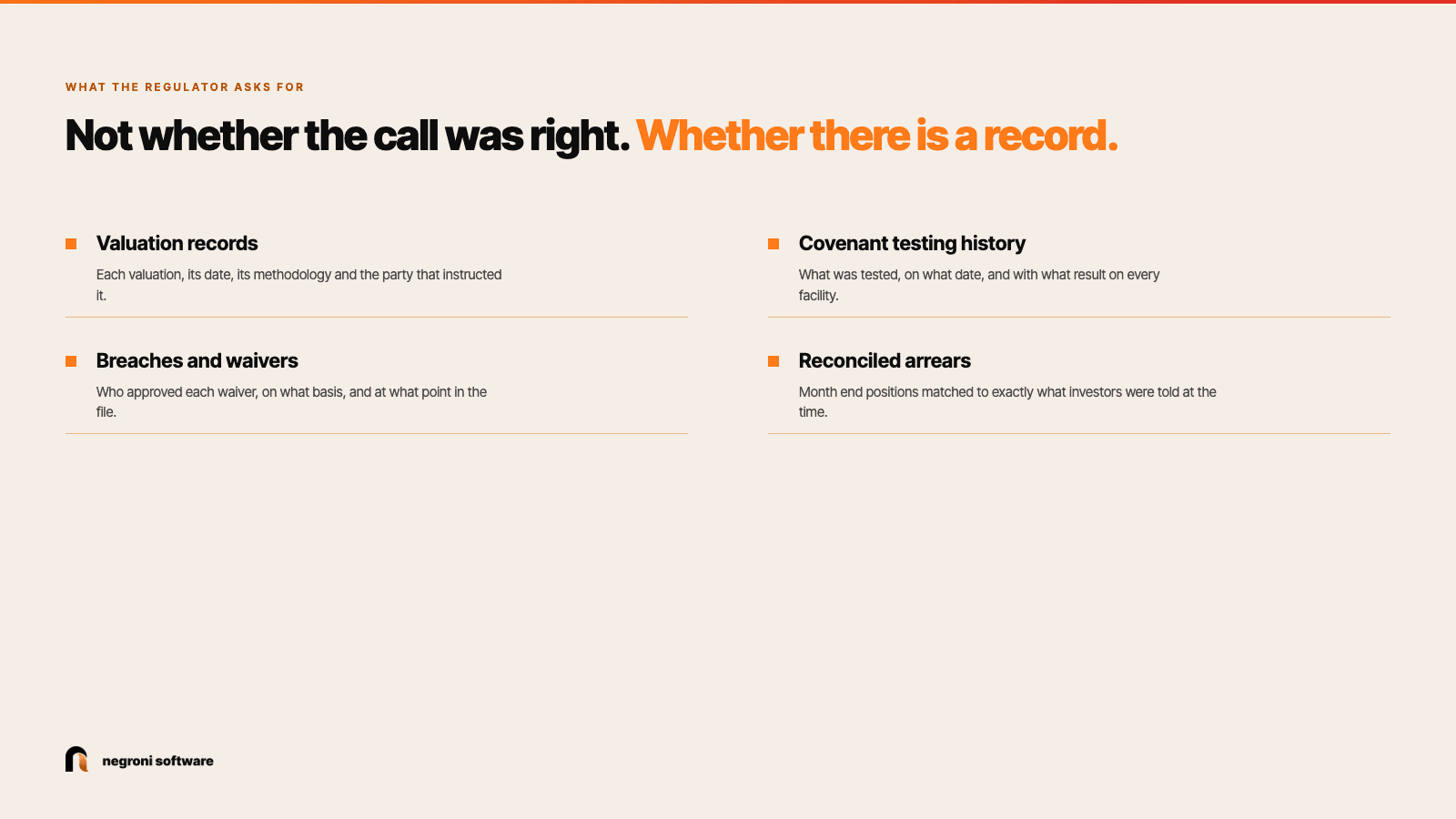
Show the valuation policy, and show that it was applied. Not the policy document; the record of each valuation, its date, its methodology, the instructing party, and the loans it supports. Show which covenants were tested, on what dates, with what results. Show which breaches were identified and how each was resolved, including waivers and who approved them. Show the arrears position at each month end, reconciled to what investors were told. Show how the unit price was struck and what inputs went into it. Show when the fund first identified deterioration on the exposures now driving the concern, and what it did in the weeks that followed.
Notice what every one of those requests has in common. None of them ask whether the credit decision was sound. They ask whether the fund's account of itself is supported by a record. A manager who can produce that record in a day is in a governance conversation. A manager reconstructing it from shared drives and inboxes is in a different conversation, and the reconstruction itself becomes the finding.
This is why the Financial Services Council's move to develop industry standards, described by chief executive Blake Briggs as an effort to strengthen investor confidence and lift industry practices, is likely to bite operationally rather than philosophically. Nobody in the sector disagrees with the principles. The work is in the plumbing that makes compliance with them demonstrable.
The valuation chain is where cracks propagate
Bullock's point about not knowing where the leverage sits has a quieter cousin: not knowing what the leverage is measured against.
Follow the chain in a development-heavy book. A valuation sets an end value. The end value sets the loan-to-value ratio. The LVR determines covenant compliance. Covenant compliance feeds the risk grade. The risk grade feeds portfolio reporting and provisioning. Provisioning feeds the net asset value. The net asset value sets the unit price at which one investor redeems and another subscribes.

Every link in that chain is defensible in isolation. The chain as a whole is only as current as its oldest input. A book carrying a meaningful share of loans on valuations struck eighteen months ago, before construction cost movement and before the cash rate moved from 3.6 percent to 4.35 percent as EY-Parthenon documented, is not carrying a valuation problem. It is carrying a unit pricing problem that has not surfaced yet.
Funds that can age their valuation inputs automatically, and can see at a glance what share of the book sits beyond policy, are managing that risk. Funds that would need to open files to find out are carrying it.
Liquidity management is a data problem before it is a capital problem
The decision to gate is ultimately about matching outflows to realisable value over time, and it requires three things a lot of Australian non-bank lenders cannot assemble quickly.
First, a current and accurate maturity ladder: what actually repays, when, under realistic rather than contractual assumptions, with construction facilities modelled on program rather than on the original schedule. Second, a defensible view of what the book is worth under stress, at position level rather than as a blended haircut. Third, a picture of correlation, because the loans most likely to extend are usually the same loans, in the same sector, in the same corridor.
Assemble those in a week and the gate is a scramble with a press release attached. Assemble them in an afternoon and the gate becomes a considered decision with a clear runway, explained to investors before they have to ask.
That difference is not about credit skill. It is about whether the loan book is queryable. This is the layer Negroni is built to supply. Negroni Automation uses AI document analysis to extract covenants, security details, valuation conditions and reporting obligations into structured fields with clause-level flagging, confidence scoring and source-document linkage, so the terms that drive everything downstream exist as data rather than prose. Negroni Management runs servicing, collections, compliance and investor reporting on that single record, with an immutable audit trail behind every action and branded investor output drawn from live portfolio data, which is the evidence file assembled continuously rather than under pressure. Negroni Analysis provides the covenant register with automatic warning and breach states, multi-scenario stress testing at position level with VaR and expected loss output, weighted average LVR, weighted average life, LVR distribution bands and geographic exposure across the whole book in minutes.
Cracks are information
The most useful thing about Court's phrasing is the word "first". A first test implies more tests, and the sector will be judged less on whether stress appeared than on how well individual managers were built to absorb it.
EY-Parthenon's read on 2026 was that performance will diverge, with differentiation coming from underwriting discipline, governance, risk management and the ability to manage complexity through a cycle. Cracks are where that divergence becomes visible to everyone at once. Managers with a live picture of their book will spend this period explaining. Managers without one will spend it discovering.
Both will be doing it in front of ASIC.
Frequently asked questions
What did ASIC say about cracks in Australian private credit? ASIC chair Sarah Court said in August 2026 that the first significant cracks had appeared in Australian private credit and that the sector faced its first real test in this country. The comments followed the collapse of property developer Bathla and came as several non-bank lenders restricted investor redemptions.
Which private credit funds have restricted redemptions in Australia? ABC News reported in August 2026 that Merricks, Longreach Credit and Centuria Bass had restricted investor redemptions, and that MA Financial had announced a temporary limit of one percent of funds under management per month. MA Financial chief executive Chris Wyke described the limit as a proactive measure in response to potential increased redemption activity.
Why do private credit funds limit redemptions? Because private credit funds hold illiquid loans while often offering investors monthly or quarterly liquidity. When redemption requests rise faster than loan repayments and new subscriptions, a fund must either sell assets into a market that knows it is a forced seller or limit outflows. Redemption limits are generally intended to protect remaining investors from value destruction caused by forced sales.
Are Australian superannuation funds exposed to private credit? Yes. Most adult Australians have some exposure to private credit through superannuation, because super funds allocate to private debt as part of their fixed income and alternatives portfolios. That indirect exposure is why stress in a wholesale lending market becomes a mainstream financial story.
What does ASIC look for when reviewing a private credit manager? ASIC's stated priorities include valuation methodology, disclosure practices and governance frameworks. In practice that means evidence: dated valuation records with documented methodology, covenant testing history, records of breaches and waivers with approval trails, arrears positions reconciled to investor reporting, and a clear account of how unit prices were struck.
How does stale valuation data affect a private credit fund's unit price? Valuations set loan-to-value ratios, which drive covenant compliance and risk grading, which flow into provisioning and net asset value, which determines the unit price at which investors redeem and subscribe. If a material share of a book is carried on valuations more than twelve months old, the reported unit price may not reflect current asset values, transferring value between redeeming and remaining investors.
Negroni is the AI-powered loan management platform for non-bank lenders, credit funds and private credit managers. Walk into an ASIC conversation with the evidence file already built. Book a demo.
Sources: ABC News, "ASIC warns of 'first significant cracks' in Australian private credit", David Taylor, 27 August 2026. Australian Financial Review, "Six key questions for private credit amid Bathla's $3.5b collapse", Jonathan Shapiro, 27 August 2026. EY-Parthenon, "Australia's private credit market enters a new phase", David Kennedy and Martie Tziotis, 22 July 2026.


