The Bank Engine Behind Private Credit’s CRE Boom (and Why It Matters for Your Fund)
Banks now hold $2.6T in credit commitments to private lenders. What back-leverage means for private credit funds, CRE risk, and how to stay ahead of it.


David Ellett
Co-Founder & CEO
Share now :


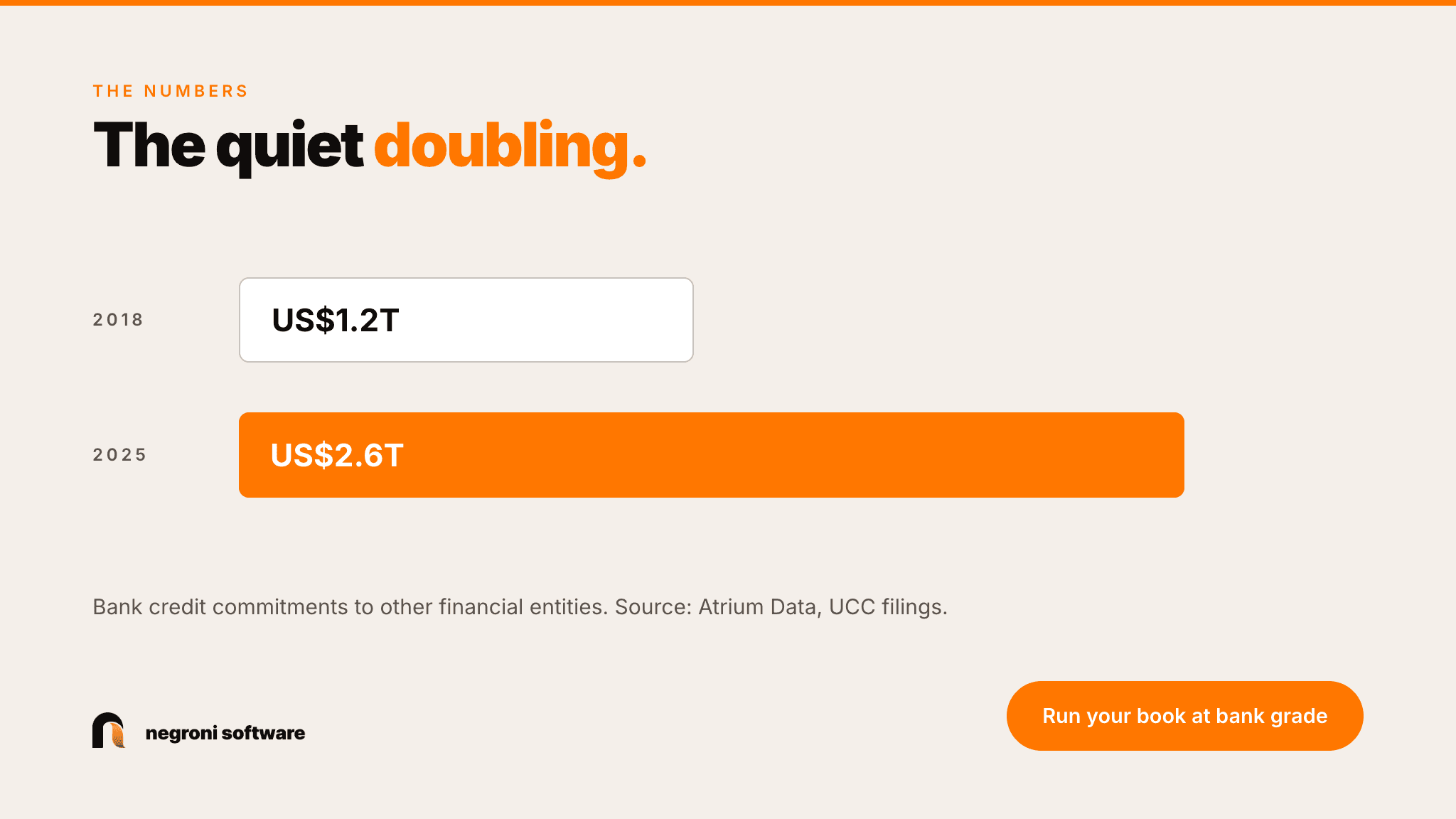
Private credit didn’t replace bank lending in commercial real estate. It rerouted it. Behind a large share of the private credit loans written against CRE assets today sits bank money, flowing through warehouse lines, subscription facilities, and repurchase agreements that never appear on the loan documents a borrower signs. Bank credit commitments to other financial entities reached US$2.6 trillion by the end of 2025, up from US$1.2 trillion in 2018, according to UCC filing data mapped by Atrium Data. Private credit’s growth story is also a bank balance sheet story, and every private credit fund should understand what that means for its own book.
How big has private credit actually become?
The numbers stopped being niche a while ago. Private credit loans accounted for roughly US$1.4 trillion, about 10% of total debt owed by US nonfinancial corporations, in the second half of 2025, according to the Federal Reserve Board. Holdings nearly doubled from US$770 billion in 2021. In commercial real estate specifically, private lenders have filled the space that banks vacated as Basel III capital rules made direct CRE exposure expensive to hold.
But vacated is the wrong word. Banks left through the front door and came back through the loading dock.
What is back-leverage, and why is it everywhere?
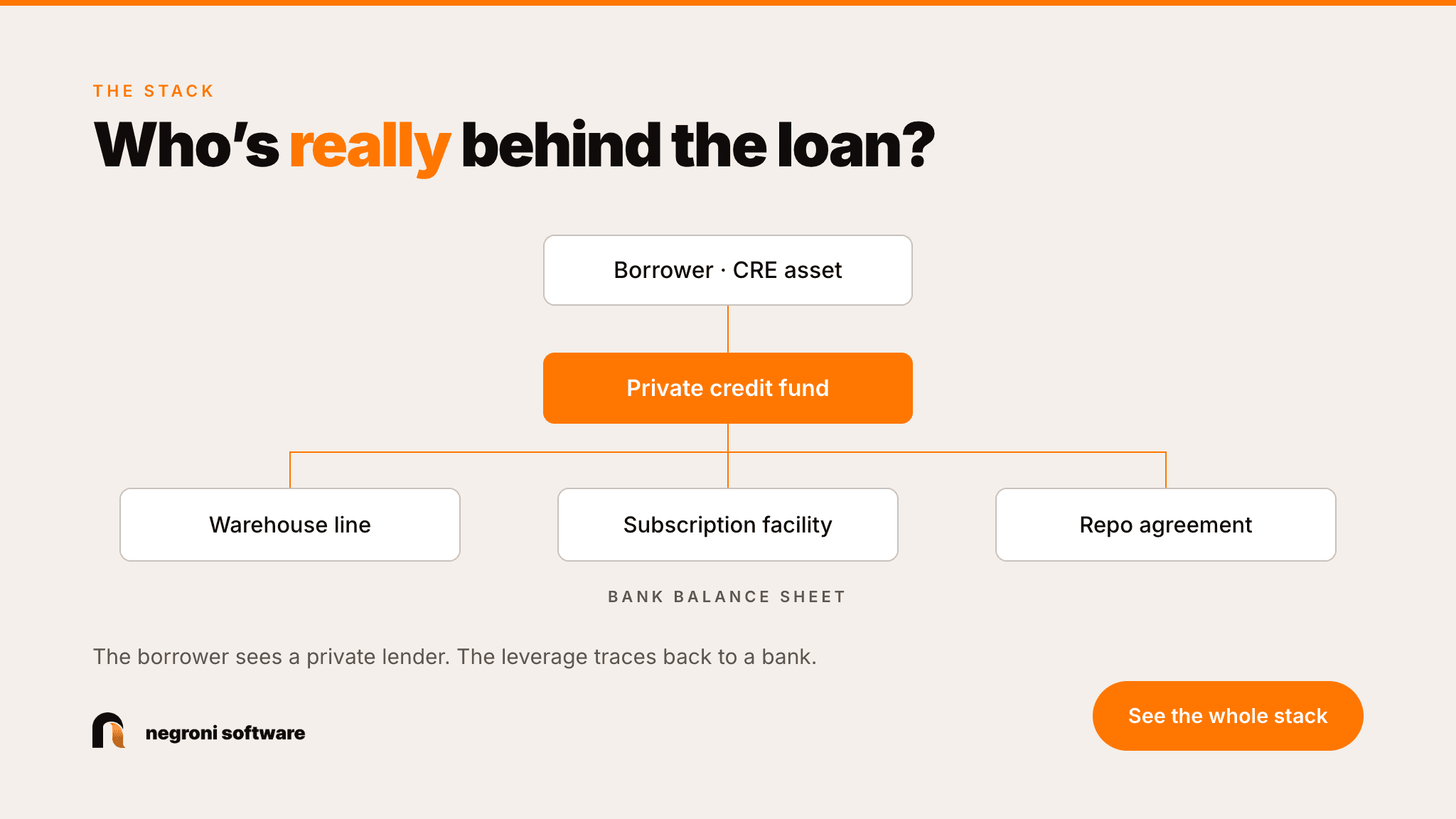
Back-leverage is bank financing extended to a private credit lender rather than to the end borrower. The fund writes the loan; the bank finances the fund. Think of it like a craft brewery that proudly sells its own label while a multinational quietly owns the brewing equipment, the delivery trucks, and a slice of every keg. The product looks independent. The supply chain isn’t.
It arrives in three main structures. Warehouse lines let a fund originate loans before term financing is in place. Subscription facilities lend against uncalled LP commitments to smooth capital deployment. Repurchase agreements let a lender sell loans to a bank with an agreement to buy them back, freeing capital to originate again. Each structure is tailored to risk appetite and regulatory treatment, and under Basel III a loan to a financial intermediary is classified as commercial and industrial lending, which carries lighter capital requirements than a direct CRE loan. The bank keeps real estate exposure economically while shedding it on paper.
Which banks are powering private credit’s CRE lending?
Atrium Data’s mapping of UCC filings, concentrated in New York City, puts names to the pattern. Bank of America leads with around 75 back-leverage filings, concentrated with TPG Real Estate and Blackstone. JPMorgan Chase shows more than 60, primarily supporting Sculptor Capital Management. Wells Fargo sits near 60, Goldman Sachs around 50 spread across nine private credit operators, and Citibank about 35, mainly channelled to Athene Global Funding, Apollo’s insurance subsidiary.
The more revealing entry is further down the league table. Axos Financial, a specialty bank a fraction of the size of the majors, appears across financing relationships with at least 30 alternative asset managers, including The Carlyle Group, Blue Owl Capital, and CRE lenders such as Madison Realty Capital. Stifel Bank runs an exclusive partnership with Oaktree’s direct lending arm; City National Bank concentrates on Kayne Anderson. The network runs deep into regional and specialty banking, not just the bulge bracket.
Has risk left the banking system, or just changed costume?
This is the question regulators are now asking loudly, and the honest answer is: nobody fully knows. If a private credit fund’s CRE book deteriorates, losses don’t stop at the fund. They travel up the repo line, through the warehouse facility, back to a bank balance sheet that reported the exposure as low-risk C&I lending. As Case Equity Partners’ Shlomo Chopp put it, these structures let lenders magnify deal volume while limiting on-paper risk.
None of this makes back-leverage bad. Used well, it’s what lets a mid-size fund compete on speed and pricing against far larger balance sheets. But it does mean the margin for operational sloppiness has shrunk. A leveraged loan book is a loan book where valuation errors compound, covenant breaches cascade, and reporting delays get expensive.
What should private credit funds do about it?
The funds that will thrive in a back-levered market are the ones that can answer hard questions quickly, because everyone in the stack is starting to ask them.
Your warehouse lender wants borrowing-base certificates that reconcile to the loan ledger, on time, every time. Your LPs want to know how much leverage sits behind their exposure and what happens to returns if it reprices. Regulators, from the Federal Reserve to ASIC here in Australia, are sharpening their focus on valuations, concentration, and interconnection across the non-bank sector. We covered ASIC’s June 30 valuation deadline in detail here.
That translates into three operational capabilities. First, a single source of truth for the loan book, because you cannot report leverage against positions you track in seventeen spreadsheets. Second, concentration and counterparty analytics that update as the book changes, not at quarter-end. Third, an audit trail that shows how every valuation and credit decision was made, so that when a financing counterparty or regulator asks, the answer takes minutes rather than weeks.
This is precisely the gap Negroni was built to close. Negroni Management gives credit funds portfolio analytics, concentration risk monitoring, and immutable audit trails in one system, and Negroni Analysis lets you stress the book against rate shifts and default scenarios in minutes. When your capital structure has a bank engine behind it, your operations need to run at bank grade.
Frequently asked questions
What is back-leverage in private credit? Back-leverage is financing a bank provides to a private credit lender, secured against the lender’s loan portfolio, rather than lending to the end borrower directly. Common structures include warehouse lines, subscription facilities, and repurchase agreements.
How much bank money sits behind private credit? Bank credit commitments to other financial entities reached about US$2.6 trillion by the end of 2025, more than double the US$1.2 trillion recorded in 2018, based on Atrium Data’s analysis of UCC filings.
Why do banks prefer back-leverage over direct CRE lending? Under Basel III, a loan to a financial intermediary is classified as commercial and industrial lending and carries lower capital requirements than a direct commercial real estate loan. Banks retain economic exposure to CRE while holding less capital against it.
Does back-leverage increase risk for private credit funds? It amplifies both returns and losses. It also raises the operational bar: leveraged funds face stricter reporting obligations to financing counterparties and less tolerance for valuation errors or data delays.
Negroni is the AI-powered loan management platform for private credit funds and non-bank lenders. See how funds run leveraged books with confidence. Book a demo.


