The Next Bathla Is Already in a Loan Book Somewhere: Four Layers That Would Find It
The sector's answer to the Bathla collapse has been industry standards and more caution at origination. Neither is a control. Here are the four architectural layers that turn a private credit loan book into a system that watches itself.


David Ellett
Co-Founder & CEO
Share now :


The sector's response to August has been fast and, on the whole, sensible. The Financial Services Council is developing industry standards, which chief executive Blake Briggs framed as strengthening investor confidence and lifting industry practices. ASIC has said the quiet part loudly, with chair Sarah Court describing the first significant cracks in Australian private credit. Credit committees around the country have tightened, and the phrase "back to basics" is doing heavy work in a lot of investor letters.
All of it is right and none of it is a control.
Standards describe an outcome. Caution is a mood, and moods regress. Six months of clean origination will restore confidence, competition will return, and the pressure to deploy will do what it always does. What survives that cycle is not resolve. It is architecture: the parts of the operation that behave the same way in a hot market as in a cold one, because they do not require anybody to remember anything.
Reserve Bank Governor Michele Bullock's observation this month, that people do not know where the leverage sits and who is exposed, is usually read as a market-level problem. It is also a description of what is true inside a great many individual loan books. Fixing the second is the only version of this any single manager controls.
There are four layers to it.
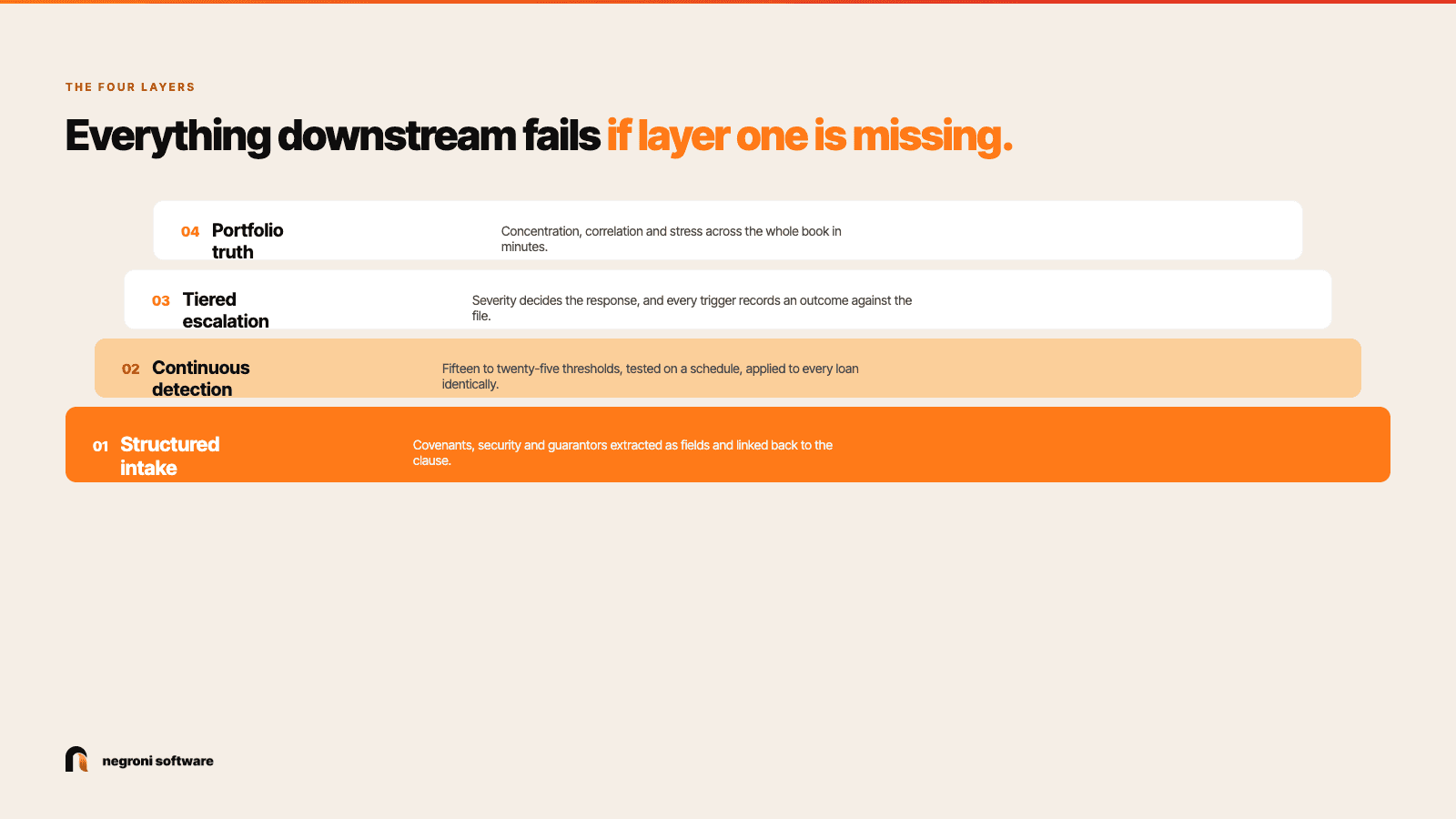
Layer one: intake, where documents become data
Everything downstream fails if this layer is missing, and in most Australian non-bank lenders it is missing.
A facility arrives as documents. A term sheet, a facility agreement, security documents, a valuation report, guarantees, a compliance certificate. Those documents contain the obligations that will govern the loan for its entire life, and in a typical fund they are filed in a shared drive and summarised into a spreadsheet by hand. The covenant exists as a sentence inside a scanned PDF. The reporting obligation exists as a calendar reminder. The guarantor exists as a name typed into a field, sometimes abbreviated, sometimes not.
You cannot monitor what you have not structured. A covenant held as prose cannot be tested automatically. A guarantor typed as free text cannot be matched across six facilities. A valuation date filed in a folder cannot be aged against policy. Every sophisticated risk capability a fund might want is downstream of this unglamorous step, which is why so many early warning projects die quietly.
The fix is extraction at intake. Parties, security, covenants, reporting obligations, valuation conditions and key dates pulled out as structured fields, each linked back to the clause it came from, with non-standard or high-risk clauses flagged and confidence scored so a human reviews the ambiguous ones rather than all of them. Do this and the loan becomes queryable on day one. Skip it and you spend the next three years paying people to re-read documents.
Layer two: detection, which runs on a schedule rather than a memory
A signal that depends on somebody remembering to check it is not a signal. It is a hope with a job title attached.
Once obligations are data, detection becomes configuration. Reporting more than ten days late. Utilisation above ninety-five percent for two consecutive months. Payment date drifting more than five days from an eighteen-month pattern. Any new registered interest against a security asset. Progress claim variance above ten percent against program. A valuation passing twelve months old. LVR crossing a covenant threshold on a revised valuation. A director resignation or adverse filing on a related entity.
Fifteen to twenty-five indicators is the right range for most books. The specific thresholds matter far less than the fact that they are written down and applied to every loan identically, every time, without anyone deciding whether this particular borrower deserves the benefit of the doubt.
That last clause is the whole point of the layer. Early signals are ambiguous and chasing them costs relationship capital on something that turns out to be nothing most of the time. Left to individual discretion, the call often does not get made, and the reason is human rather than negligent. Systems do not hesitate. That is not a criticism of relationship managers, it is the reason the trigger belongs in the system and the judgement belongs in the person who receives it.
Layer three: escalation and the closed loop
An early warning framework that treats every trigger as urgent gets ignored inside a month. Tiering is what makes it survivable.
One low-severity trigger produces a file note and a review date. Two triggers on the same facility inside sixty days produce a borrower call and a fresh register search. A high-severity trigger, or three amber signals, routes straight to credit committee with a recommendation attached. The tiers are what let a credit team run a monitoring framework across three hundred loans with the team they already have.
The closed loop is the part most funds skip and most regret. Every triggered signal needs a recorded outcome: investigated and cleared, monitored, escalated, or acted on. That does two things, and both are worth more than they look.
It creates the evidence trail. When a large exposure fails, the inquiry is rarely about whether the credit decision was wrong, because credit decisions are allowed to be wrong. The inquiry is about process, and specifically about what the fund knew, when, and what it did next. A manager who can hand over a time-stamped action history is in a governance conversation. A manager reconstructing it from email threads is in a finding.
It also lets you tune. After twelve months you can see which signals actually predicted trouble in your book and which generated noise, which is how a generic framework becomes your framework.
Layer four: portfolio truth
The first three layers protect you loan by loan. The fourth protects you from the risk that no loan-level review can see.
Three facilities to one sponsor is a concentration. Eleven loans with the same capitalisation structure, in the same corridor, funded in the same vintage, is a single position wearing eleven file numbers. EY-Parthenon identified real estate development, construction, hospitality, retail, and transport and logistics as the sectors under pressure in 2026, which means a lot of Australian books are carrying correlation they have never priced.
Portfolio truth means being able to ask, and answer quickly: what is the weighted average LVR and weighted average life of this book, and how have they moved? What share sits in each LVR band and each risk grade? What is the geographic and vintage concentration? What happens to expected loss and value at risk under a base, moderate and severe scenario at position level rather than as a blended haircut? Which loans extend rather than repay under stress, and what does that do to the fund's liquidity ladder?
Funds that can produce those answers in an afternoon manage this risk. Funds that need two weeks carry it and call it diversification.
What this looks like assembled
Those four layers are the product. Negroni Automation is layer one and layer two: AI document analysis with entity extraction, clause-level flagging, confidence scoring and audit trail preserved, feeding multi-step sequences and schedule-based or event-based processes with run history, SLA alerts and completion reporting. Negroni Management is layer three: servicing, collections, compliance and reporting on one record, with an immutable audit trail behind every action and investor-grade output drawn from live portfolio data rather than assembled by an analyst. Negroni Analysis is layer four: a structured covenant register with automatic warning and breach states, multi-scenario stress testing with VaR and expected loss across eight-quarter projections, LVR distribution, risk rating mix, geographic exposure, vintage and maturity analysis.
Harbour Credit Partners runs more than one hundred loan positions on it. The relevant claim is not that the platform is clever. It is that a hundred positions on a connected record behave like a portfolio, and a hundred positions across spreadsheets, inboxes and shared drives behave like a hundred separate problems that occasionally coincide.
Where to start, if you are starting
Do not begin with a platform decision. Begin with a stopwatch.
Pick your three largest sponsor relationships and assemble complete exposure from scratch, timing yourself honestly, including guarantor and director connections. Then run the same exercise for register currency: when was the last search against your twenty largest security assets. Then age your valuations and calculate what share of the book sits beyond your own policy. Three tests, one week, no vendors.

Whatever those tests return is your actual risk position, and it will be some distance from the one in your last investor report. That gap is the project.
Bathla is being called the sector's first real test. Tests are only expensive if you fail the retake, and the retake is already being written into somebody's loan book right now.
Frequently asked questions
What is private credit risk management software? Private credit risk management software is a system that holds loan terms, covenants, security details and counterparty relationships as structured data, monitors them continuously against defined thresholds, escalates breaches and warning signals through a tiered process, and models portfolio-level exposures such as concentration, correlation and stress scenarios. It replaces the combination of spreadsheets, shared drives and calendar reminders most non-bank lenders use.
How many early warning indicators should a private credit lender monitor? Most non-bank lenders are well served by fifteen to twenty-five clearly defined indicators with explicit thresholds, tailored to their asset classes. Consistency matters more than volume: a small set of signals applied automatically to every loan outperforms a longer list applied selectively when someone has time.
Why does covenant monitoring need structured data? Because a covenant held as a sentence inside a scanned facility agreement cannot be tested automatically. Converting covenants into structured fields with defined tests, thresholds and reporting dependencies allows breach and warning states to be calculated against live loan data, rather than depending on an analyst manually checking each facility against each document.
What evidence does a private credit manager need during a regulatory review? Typically a dated record of valuations and the methodology applied, a covenant testing history, records of identified breaches and any waivers with approval trails, arrears positions reconciled to investor reporting, and a time-stamped account of when deterioration was first identified and what actions followed. Producing that from an immutable audit trail is a governance conversation; reconstructing it from email is usually a finding.
How does portfolio stress testing differ from loan-level credit review? Loan-level review assesses each facility on its own merits. Portfolio stress testing measures how many positions deteriorate together under a common shock, such as a valuation decline in one asset class or geography, and what that means for expected loss, value at risk and fund liquidity. Correlated exposures are invisible to loan-level review because each individual file can look sound.
Can a small private credit fund justify this infrastructure? Yes, and usually more easily than a large one, because a small team has less capacity to absorb manual monitoring. The economics are about operational leverage: growing assets under management without growing operations headcount, which is what allows a lean fund to run a book of one hundred or more positions with institutional-grade monitoring.
Negroni is the AI-powered loan management platform for non-bank lenders, credit funds and private credit managers. Build the book that watches itself. Book a demo.
Sources: ABC News, "ASIC warns of 'first significant cracks' in Australian private credit", David Taylor, 27 August 2026. EY-Parthenon, "Australia's private credit market enters a new phase", David Kennedy and Martie Tziotis, 22 July 2026. Australian Financial Review, "Bathla collapse may be Australian private credit's cockroach moment", Chanticleer, 25 August 2026.


