How Negroni Would Have Seen Bathla Coming: A Signal-by-Signal Walkthrough
No software stops a property developer from failing. What software does is make the warning signs visible while a lender still has options. A signal-by-signal walkthrough of the Bathla timeline through a monitored loan book.


David Ellett
Co-Founder & CEO
Share now :


Let us be honest about the limits of the claim first, because the version of this argument that overreaches is not worth reading.
Software would not have stopped Bathla from failing. It would not have changed the group's debt load, its cash position, its building practices or the market conditions it was building into. It would not have made the credit call for any lender, and it would not have talked anyone out of a deal they wanted to write. Software has no opinion about whether a sponsor is good for the money.
What software does is narrower and, in this case, more valuable. It watches. It watches every facility, every entity, every obligation and every register, continuously, without getting busy, without deciding that a slightly late reporting pack is not worth an awkward phone call, and without forgetting what it saw four months ago. The Australian Financial Review's Chanticleer column argued on 25 August that private credit lenders should have seen Bathla's demise coming, given concerns about debt levels, cash flow and building practices that had been escalating for months. Jonathan Shapiro made a similar point two days later: the developer was always a high-risk proposition, and most lenders knew it.
So the question is not whether the information existed. It is why the information did not become a decision. This is a walkthrough of what a monitored loan book does with the kind of signals a group in that position generates, and when.
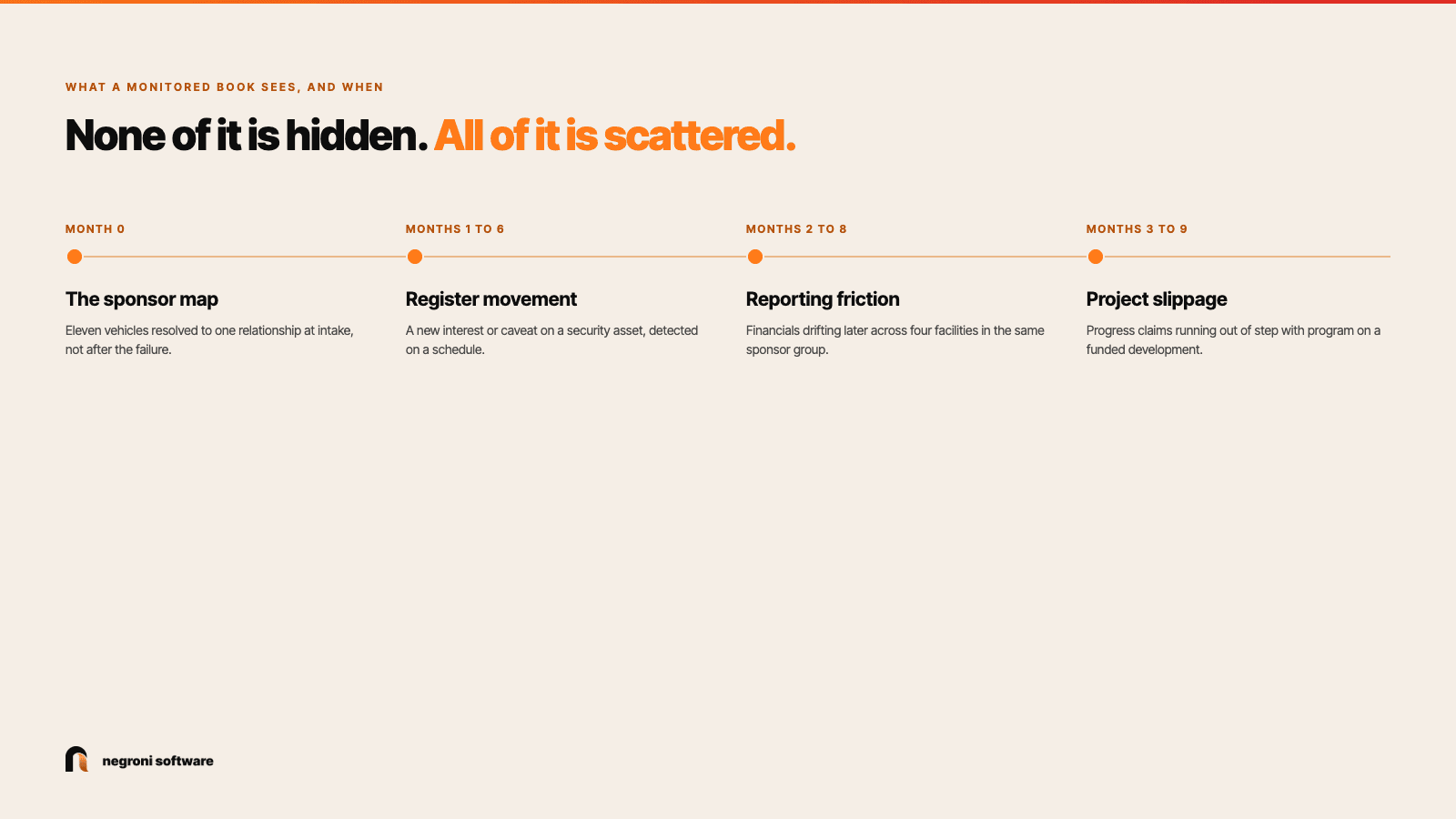
Month zero: the sponsor map, built at intake
The first thing a system does is refuse to accept a borrower name as a string.
When a facility is onboarded through Negroni Automation, AI document analysis reads the term sheet, the facility agreement, the security documents and the valuation report, and extracts the parties into structured records: borrower entity, parent, guarantors, directors, related trusts, security properties with titles. Entity resolution links them, so a sponsor lending through eleven special purpose vehicles is eleven facilities and one relationship.
That is not a monitoring feature. It is the precondition for every monitoring feature that follows. Without it, a fund with six facilities across one sponsor group has six independent files, each of which looks reasonable. With it, the fund has a single exposure number, visible from day one and updated automatically as new facilities are written.
For a development empire of any complexity, this is the difference between knowing your position and calculating it. Funds now working through the Bathla administration are, in many cases, calculating.
Months one to six: register movement, watched rather than searched
Most Australian lenders run register searches at settlement. Very few run them again on a schedule.
That is understandable when the search is a manual task assigned to someone, and unforgivable when it is a scheduled process. Negroni Automation runs event-based and schedule-based processes with full run history and audit logging, which means a recurring check against security assets and related entities is a configuration rather than a habit. A new security interest registered against a property you hold, a caveat lodged, an adverse filing against a director, a statutory demand: these are the signals that appear before a borrower volunteers anything, and they are the signals most likely to be missed because nobody owns the task of looking.
When one appears, it does not become an email that somebody may or may not open. It becomes a triggered signal with a severity, an owner and a required outcome.
Months two to eight: reporting friction, measured instead of tolerated
Late financials are the single most reliable early signal in secured lending, and the most consistently forgiven.
The forgiveness is rational at an individual level. A borrower whose management accounts used to arrive on the fifteenth and now arrive on the twenty-eighth after two reminders is annoying, not alarming, and chasing it costs relationship capital on something that will be nothing most of the time. The forgiveness is irrational at a portfolio level, because reporting friction almost always precedes cash friction, and because the pattern only means something when you can see it across months and across facilities.
Negroni Automation holds reporting obligations as structured fields extracted at intake, so due dates are data rather than diary entries. The system knows what was due, what arrived, when, and how that compares to eighteen months of behaviour. A borrower drifting from consistently early to consistently late across four facilities in the same group is not a scheduling problem. It is a liquidity problem announcing itself politely, and it is invisible in a book where each due date lives in a different analyst's calendar.
Months three to nine: project slippage, because development fails on site first
In construction and development lending, the earliest signal is almost always physical rather than financial. Progress claims stop matching the program. A quantity surveyor notes a variation the borrower has not raised. A builder is replaced mid-project. Presales fail to convert. A certificate that should have issued last month has not.
Chanticleer specifically referenced building practice concerns among the issues escalating around Bathla in the months before administration. In a monitored book, progress claim variance against program is a defined threshold with a trigger attached, tested every time a claim is processed rather than reviewed when someone has time. Ten percent variance generates a file note. A second variance inside a defined window generates a borrower call and a fresh register search. A third, or a high-severity event like a builder replacement, routes to credit committee with a recommendation.

Development finance deteriorates on the site long before it deteriorates in the bank account. The lenders who recover well are the ones who read the site.
Across the book: correlation, which single-loan review cannot see
Some deterioration is not about one borrower at all.
Negroni Analysis carries the portfolio layer, and this is where the picture changes shape. Weighted average LVR and weighted average life across the book. LVR distribution bands. Risk rating mix across investment grade, sub-investment and watch list. Geographic exposure. Vintage and maturity analysis. Multi-scenario stress testing at position level, with VaR and expected loss output across eight-quarter projections.
Run a fifteen percent development valuation shock across a Sydney-weighted residential book and you do not get a view on one sponsor. You get a count of how many facilities breach LVR covenants simultaneously, how much of the book moves to watch list, and what the fund's liquidity position looks like when those loans extend rather than repay. That is the number that should have driven position sizing long before any single borrower failed, and it is a number most Australian non-bank lenders can only produce with two weeks of notice.
What the system actually produces
Put the signal families together and a monitored book does not produce a prediction. Predictions are not the product, and any vendor promising one should be shown the door.
What it produces is a dossier: a single sponsor exposure figure current to the minute, a chronological record of every triggered signal across every facility in the group, the outcome recorded against each, the covenant register with automatic warning and breach states, and a portfolio view showing how much else in the book moves if this position moves. It arrives at the credit committee as a file rather than as a feeling, and it arrives in month three rather than month nine.
Negroni Management runs servicing, collections, compliance and reporting on that same record, with an immutable audit trail behind every action. Which means the second dossier, the one for ASIC or the auditor or the investor who wants to know what the fund knew and when, is a byproduct of the first rather than a project.
The counterfactual that matters is not prevention
Here is the honest version of the claim in this headline.
A monitored loan book would not have prevented Bathla's collapse. It would have changed what individual lenders were doing in the months before it, and that is where the money is. A lender who identifies deterioration at month two has the full toolkit: restructure, additional security, a sponsor equity injection, an orderly sale, a refinance to another lender who has not yet seen the problem, or simply a decision not to write the next facility into the same group. A lender who identifies it at month nine has enforcement and a queue.
Same loan. Same borrower. Same market. Very different outcome, and the only variable is how early somebody noticed.
Reserve Bank Governor Michele Bullock said this month that people do not know where the leverage sits and do not know who is exposed. That is a statement about the market, but it is built from hundreds of individual books where the same is true internally. The fix is not more caution at origination. It is a book that can see itself.
Frequently asked questions
Could software have prevented the Bathla collapse? No. No loan management platform prevents a borrower from failing, changes market conditions, or makes a credit decision on a lender's behalf. What monitoring software changes is the timing of a lender's response, by detecting deterioration signals such as reporting delays, register movements and project slippage while remedies like restructure, additional security or orderly sale are still available.
What early warning signals appear before a property developer collapses? Typically four families of signal: behaviour around the facility itself, including utilisation pinned at the limit and payment dates drifting later; reporting friction, meaning financials arriving late or incomplete; register and counterparty movement, such as new security interests, caveats, director changes or adverse filings; and project-level slippage, including progress claims out of step with program, replaced builders and presales failing to convert. Each usually appears months before a missed payment.
Why do lenders miss warning signs they already know to look for? Because the signals live in different systems. Payment behaviour sits in a servicing spreadsheet, reporting due dates in a diary, covenants inside scanned PDFs, register searches in a task nobody has repeated since settlement, and progress claims in an inbox. Deterioration is a pattern across those fragments rather than an event inside any one of them, so a fund can hold all the evidence and none of the conclusion.
What is entity resolution in a loan management system? Entity resolution links borrower, parent, guarantor, director and related-trust records across separate facilities to a single relationship, rather than storing each name as free text in an individual file. It allows a lender to see total exposure to a sponsor across every facility, including exposures where the sponsor appears only as a guarantor, without manually searching files.
How quickly should a lender be able to calculate total exposure to a sponsor? Immediately. If total sponsor exposure requires opening files or building a spreadsheet, the lender is reconstructing its position rather than knowing it, which typically takes days during precisely the period when speed determines recovery options.
What does Negroni do for private credit lenders? Negroni is an end-to-end AI-powered loan management platform for non-bank lenders, credit funds, family offices and private credit managers. Negroni Automation handles origination, AI document analysis and workflow automation. Negroni Management runs servicing, collections, compliance and investor reporting on a single record with an immutable audit trail. Negroni Analysis provides covenant registers, portfolio stress testing, concentration analysis and portfolio reporting across the whole book.
Negroni is the AI-powered loan management platform for non-bank lenders, credit funds and private credit managers. See deterioration at month two, not month nine. Book a demo.
Sources: Australian Financial Review, "Bathla collapse may be Australian private credit's cockroach moment", Chanticleer, 25 August 2026. Australian Financial Review, "Six key questions for private credit amid Bathla's $3.5b collapse", Jonathan Shapiro, 27 August 2026. ABC News, "ASIC warns of 'first significant cracks' in Australian private credit", David Taylor, 27 August 2026.


