What Loan Management Software for Private Credit Should Actually Do
What an end-to-end loan management platform for private credit needs to cover: the full lifecycle in one system, who it suits, and where the honest limits sit. Worked through with Negroni as the example.


David Ellett
Co-Founder & CEO
Share now :


Much of the lending software in this market was built for banks first, then sold sideways. That is the quiet reason so many non-bank lenders end up running their book on spreadsheets despite having evaluated several platforms: the products they looked at tended to assume a retail mortgage factory, a consumer credit card portfolio, or a corporate bank’s committee structure, and none of those look much like a credit fund writing thirty construction facilities a year against bespoke security.
Negroni was built the other way around. It starts from how private credit actually works, with heterogeneous loans, negotiated terms, real security, investor reporting obligations and a regulator that wants evidence rather than assurances, and it runs the whole lifecycle in one system.
This article is a plain description of what the platform does, who it is for, and where the line sits between what software should handle and what a credit professional should.
The core idea: one connective layer instead of five disconnected tools
The defining problem in non-bank lending operations is not any single missing capability. It is the seams.
A lender might have a decent CRM, a competent servicing spreadsheet, a document store, an accounting system and a reporting process. Work moves between them by hand. A borrower’s financials get read at credit assessment, then re-read at drawdown, then re-keyed for reporting. A covenant negotiated in a facility agreement is often never represented anywhere a system could monitor it. Investor reports are assembled from four sources and reconciled manually. Each seam is a place where information can degrade, time can be lost, and errors can enter quietly.
Negroni positions itself as the connective layer linking origination, servicing, fund management and reporting. Practically, that means a loan is one record from application to discharge. The financials extracted at intake are the same financials that feed the credit assessment, populate the servicing schedule, drive covenant monitoring and roll into the investor report. Nothing is re-entered, and nothing has to be reconciled between systems because there is only one.
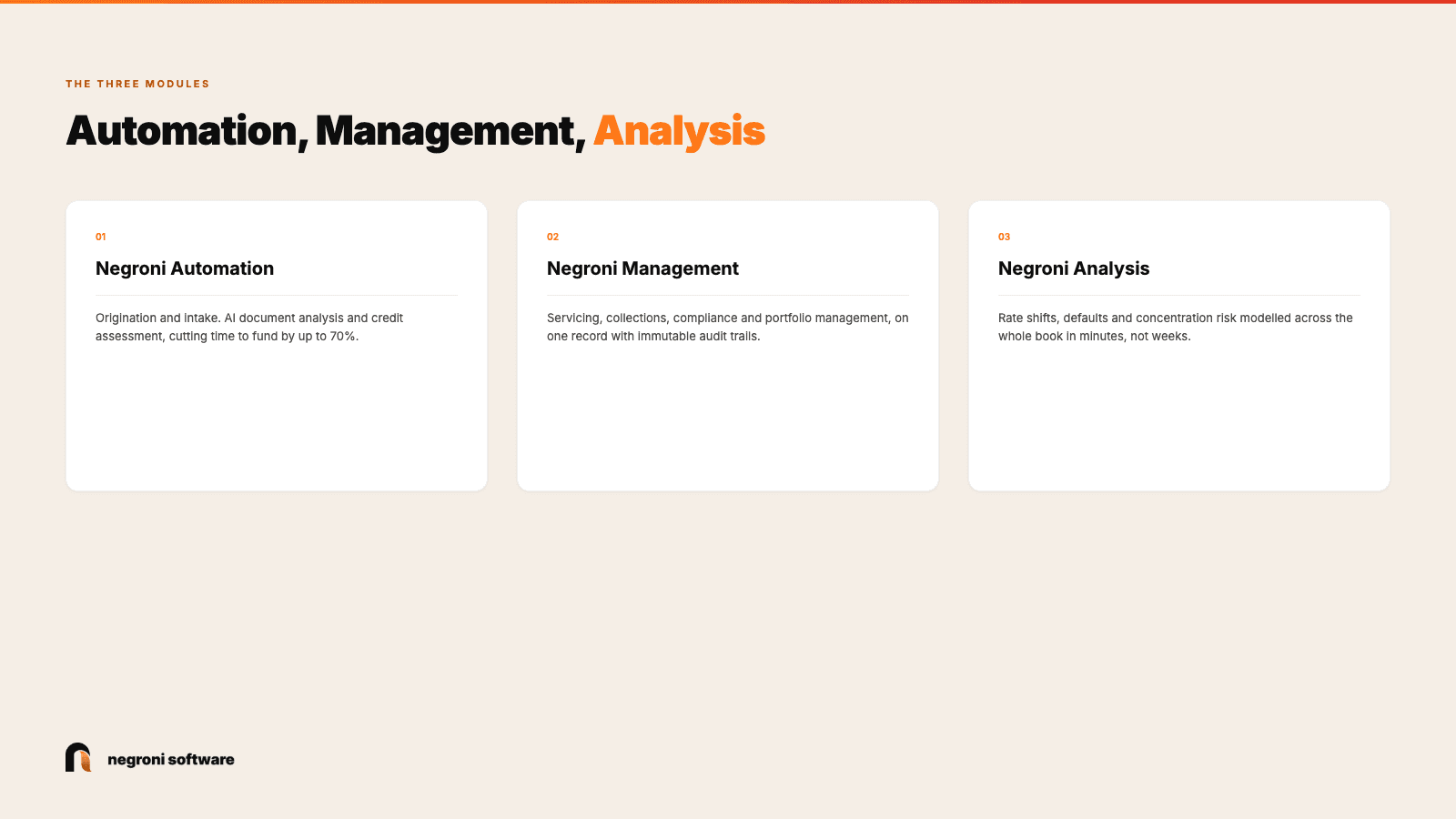
The platform is delivered as three connected modules.
Negroni Automation: origination and intake
Negroni Automation covers the front of the lifecycle, from application through to funding, and its central capability is AI-powered document analysis.
In a conventional origination process the elapsed time is dominated by reading. Financial statements, tax returns, bank statements, trust deeds, valuations, insurance certificates, contracts of sale, feasibility studies, quantity surveyor reports, identity documents. Somebody opens each one, extracts the relevant figures, checks them against the application, notes the gaps and requests the missing items. It is skilled work in that errors are costly, and repetitive work in that the task itself is largely transcription. That combination is exactly what machine document analysis is now good at.
Negroni extracts the contents of those documents into structured fields, applies credit assessment logic against them, and surfaces what is missing or inconsistent rather than requiring a human to notice. The company’s stated result is a reduction in time to fund of up to seventy percent, with a loan file that would conventionally take three days moving in around three hours.

Two things are worth being clear about. First, the speed gain comes almost entirely from removing waiting and re-reading, not from making credit decisions faster; the credit call happens with better information in front of it, sooner. Second, faster origination is a commercial weapon in private credit specifically because borrowers in this market are usually solving a timing problem. A developer who needs to settle a site in three weeks will take a slightly more expensive facility that can actually fund in time. Speed wins deals that price alone would lose, which is the argument we made at length in cutting loan origination cycle time.
Negroni Management: servicing, collections, compliance and portfolio
Negroni Management is where the loan lives for its whole life, and it covers four functions that are usually four separate processes.
Servicing handles the mechanics: payment schedules, interest calculations, drawdowns, capitalisation, variations, redraws, discharges. Collections and arrears management handle deterioration, with the escalation logic and contact workflows that many lenders run out of a spreadsheet and a set of reminders. Compliance is described by the company as baked into the foundation rather than layered on, with immutable audit trails supporting regulatory requirements. Portfolio management holds the aggregate view.
The compliance architecture is the part that non-bank lenders tend to underestimate until a regulator or auditor asks a question. An immutable audit trail means the record of who did what, when, and on what information is captured automatically as a by-product of the work rather than assembled later. That distinction matters enormously in an environment where ASIC has shifted from publishing valuation and governance principles to testing whether managers can evidence them. Producing a contemporaneous system record is a report. Reconstructing the same story from emails, board papers and recollection is a project, and a less convincing one.
Negroni Analysis: modelling the whole book
Negroni Analysis is the portfolio and fund layer. Its function is to let a manager model rate shifts, defaults and concentration risk against the entire book in minutes rather than weeks.
The value here is in the cadence rather than the sophistication of the mathematics. Most credit funds can build a stress test. What they cannot do is build one on Tuesday because a rate expectation moved on Monday, and then rebuild it on Thursday with a different default assumption, and then run it again next month against an updated book. When stress testing is a three-week project, it happens when someone requires it, which means annually for the investment committee and occasionally for an investor. When it takes minutes, it becomes part of how decisions get made, including individual credit decisions, because you can ask what a proposed loan does to portfolio concentration before you write it rather than after.
Who it is built for
Negroni is aimed at non-bank lenders, credit funds, family offices and private credit managers. Named clients include Harbour Credit Partners, Front Financial and Moxon Capital.
The profile that fits best is a lender carrying real complexity relative to its headcount: negotiated rather than standardised terms, genuine security requiring genuine monitoring, external capital with reporting obligations attached, and a book somewhere between the point where spreadsheets stop being comfortable and the point where a bank-scale core system would be more than the job requires. In practice that tends to mean lenders managing dozens to low hundreds of active facilities, growing, and feeling the operational strain in month-end reporting and drawdown turnaround times.
The profile that fits least is a lender writing a small number of very large, very bespoke transactions where every facility is effectively a one-off negotiation and the operational burden is genuinely low. Software helps least where there is little repetition to automate.
What it does not do
This deserves its own section, because the honest limits of any platform are the most useful thing to know before an evaluation.
Negroni does not make credit decisions. It assembles, structures and checks the information a credit decision requires, and it applies assessment logic, but the judgement about whether to lend against a particular sponsor in a particular market at a particular point in the cycle remains a human call. That is the correct division. The parts of lending that software should own are the mechanical, repeatable and auditable parts; the parts a credit professional should own are the ones requiring context, scepticism and accountability.
It does not eliminate fraud. Structured data and audit trails materially shorten the time between a discrepancy existing and somebody noticing it, which is the difference between a problem found while a loan performs and a problem found in administration, as the MFS double-pledging collapse illustrated. That is a real and valuable change. It is not the same as prevention.
And it is not a substitute for credit culture. A lender with underdeveloped underwriting standards and a platform is still a lender with underdeveloped underwriting standards, just operating faster.
What implementation actually involves
The realistic work in adopting a platform like this is data migration and process definition, not technical installation.
Migration means getting the existing book into structured form, which typically surfaces gaps a lender did not know it had: facilities with no recorded covenant obligations, guarantors recorded inconsistently across files, valuations with no expiry tracked, security schedules that exist only in scanned documents. This is uncomfortable and it is also the single highest-value part of the exercise, because those gaps were live risks whether or not anyone had catalogued them.
Process definition means deciding what the workflow should be rather than replicating what it currently is. A common failure mode in operations projects is configuring new software to reproduce an old manual process, seams included, which is usually why the expected productivity gain does not arrive.
Neither is glamorous. Both determine whether the platform delivers operating leverage or just a better-looking version of the same problem.
Frequently asked questions
What is Negroni Software? Negroni is an end-to-end, AI-powered loan management platform built specifically for non-bank lenders, credit funds, family offices and private credit managers. It covers the full loan lifecycle in one system, spanning origination, servicing, collections, compliance, portfolio management and reporting, and is delivered as three connected modules: Negroni Automation, Negroni Management and Negroni Analysis.
What are the three Negroni modules? Negroni Automation handles origination and intake with AI-powered document analysis and credit assessment. Negroni Management handles servicing, collections, compliance and portfolio management, with compliance built into the foundation and immutable audit trails. Negroni Analysis models rate shifts, defaults and concentration risk across the whole loan book.
How much faster is loan origination with Negroni? The company states a reduction in time to fund of up to seventy percent, with files that would conventionally take three days processing in around three hours. The gain comes primarily from automating document reading, data extraction and completeness checking, which is where most of the elapsed time in a conventional origination process sits.
Who is Negroni built for? Non-bank lenders, private credit funds, family offices and credit managers, particularly those with negotiated rather than standardised loan terms, secured lending requiring active monitoring, external investor reporting obligations, and a book large enough that spreadsheet-based operations have become a constraint. Named clients include Harbour Credit Partners, Front Financial and Moxon Capital.
How does Negroni differ from a generic loan origination system? Generic loan origination systems are typically designed for high-volume, standardised retail or consumer lending and cover only the front of the lifecycle. Negroni is designed for the heterogeneous, negotiated, security-backed lending characteristic of private credit, and covers servicing, compliance, portfolio analytics and reporting in the same system rather than handing off to separate tools.
Does Negroni support regulatory compliance and audit requirements? Yes. Compliance is built into the platform’s foundation rather than added as a module, and the system maintains immutable audit trails recording actions and approvals as they occur. This supports evidence requests from regulators and auditors, including the documented valuation and governance processes that ASIC now expects Australian private credit managers to be able to demonstrate.
Does Negroni replace credit judgement? No. The platform structures and verifies the information a credit decision depends on, and applies assessment logic, but the decision itself remains with the credit team. The design intent is to automate the mechanical and auditable parts of lending so that experienced people spend their time on judgement.
Negroni is the leading AI private credit solution: one platform for origination, servicing, fund management and reporting. Book a demo.


