Double-Pledged: The MFS Collapse and the Collateral Your Loan Book Cannot See
A GBP 930 million collateral shortfall at Market Financial Solutions has put double-pledging back on every credit committee’s agenda. What it means for non-bank lenders, and why verification is now an architecture problem.


David Ellett
Co-Founder & CEO
Share now :


Every secured lender operates on one quiet assumption: that the asset behind the loan is actually there, and that nobody else has a prior claim on it. The whole edifice of private credit rests on that assumption. Pricing, ranking, recovery modelling, the confidence you carry into an investment committee, all of it depends on collateral being what the file says it is.
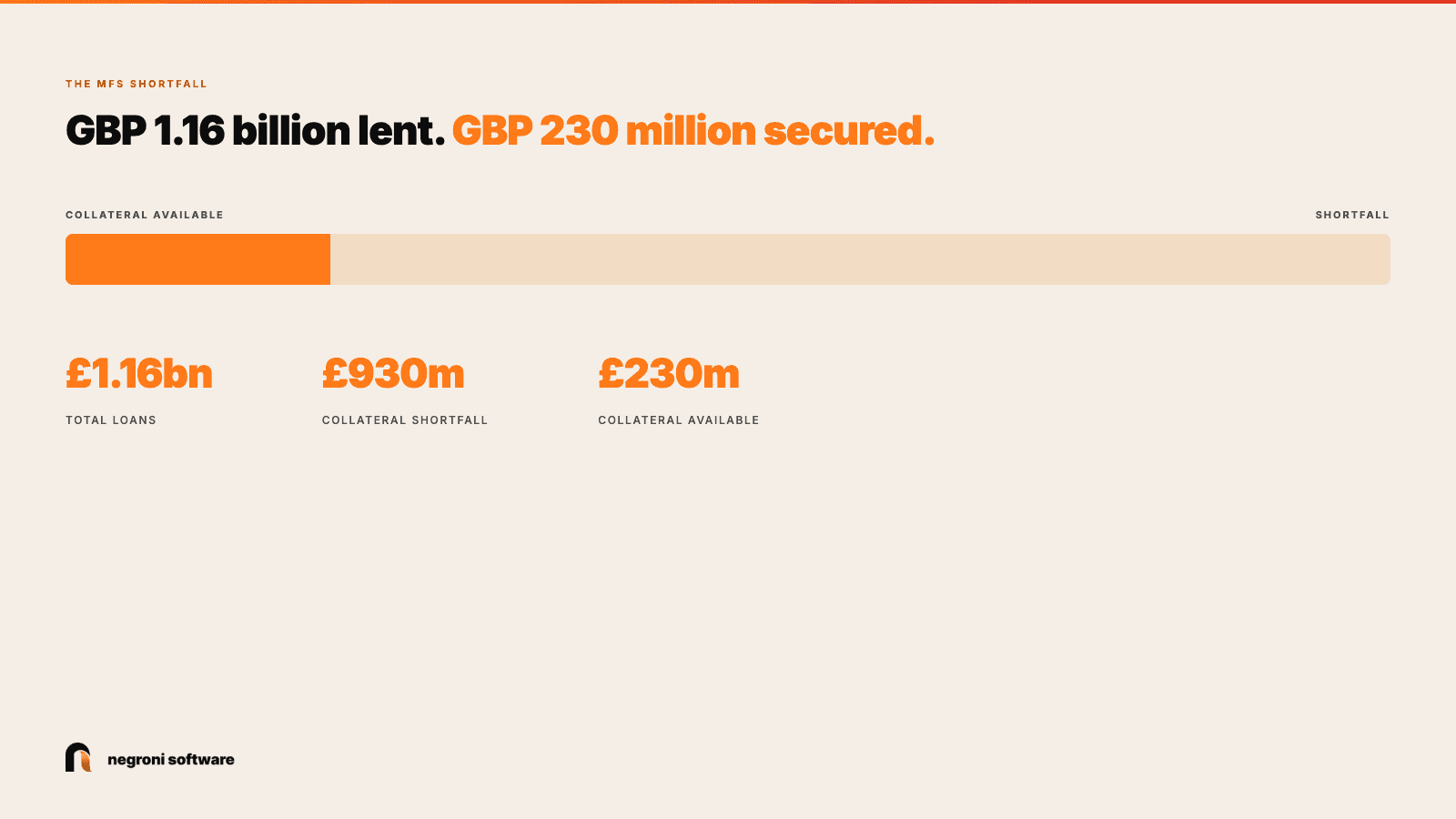
On 25 February 2026, that assumption failed at scale. U.K. bridging lender Market Financial Solutions was placed into administration after allegedly double-pledging assets, producing a collateral shortfall of roughly GBP 930 million against total loans of GBP 1.16 billion. Lenders were left looking at about GBP 230 million of available collateral to cover the whole book. Warehouses defaulted. Banks booked losses they had modelled as nearly impossible.
The uncomfortable part is not that a lender failed. Lenders fail. The uncomfortable part is that the failure was invisible to sophisticated counterparties right up until the moment it wasn’t.
What double-pledging actually is, and why it is so hard to catch
Double-pledging happens when the same collateral is used to secure more than one loan, with each lender believing it holds first-lien priority. Two funds, two files, two sets of security documents, one asset. When the borrower defaults, the first genuine lienholder takes the collateral and the other “first” lienholder discovers it holds an unsecured claim dressed up as a secured one.
Manatt, Phelps & Phillips, in its client alert on the MFS administration, identifies two roots. The first is negligence: a borrower allocating collateral across multiple facilities without tracking what has already been committed, usually because its own records are as fragmented as its lenders’. The second is deliberate fraud, where a borrower pledges the same asset repeatedly to inflate its borrowing capacity. The alert’s authors, Brian S. Korn, Bernhard Alvine and Janice Kim, are direct about the implication: fraudulent practices like double-pledging may be far more prevalent than the industry assumed, and they are a global risk rather than a jurisdictional quirk.
Think of it as an airline selling the same seat to four passengers. Nothing looks wrong at any point in the process. Every booking confirmation is real, every payment clears, every passenger has a valid ticket. The problem only surfaces at the gate, and by then there is nothing to negotiate over.

MFS is not an isolated event, it is the third data point
The reason credit committees reacted so sharply is that MFS landed on top of a pattern already forming.
First Brands, the Ohio auto parts group, was accused of double and triple-pledging collateral and falsifying invoices before entering bankruptcy proceedings in late 2025. Tricolor, a Dallas subprime auto lender, double-pledged collateral and altered the characteristics of the assets it had pledged. Both collapsed within months of each other, across different asset classes, in different corners of the credit market.
Jamie Dimon put the industry’s own complacency on the record in February 2026, observing that he could see a couple of people doing some dumb things in private credit markets, and drawing the parallel nobody in the sector wants drawn: the conditions preceding 2008. You can dismiss that as a bank CEO talking down a competitor. You can also notice that three separate collateral frauds surfaced in under six months, and that in each case the losses landed on lenders who had performed conventional diligence and found nothing.
Conventional diligence is the point of failure here. Not lazy diligence. Conventional diligence.
The Australian question: could it happen here?
Australian lenders have one structural advantage and one structural blind spot.
The advantage is the Personal Property Securities Register. For most non-land collateral, a registered security interest creates a searchable public record, and priority rules are relatively clear. A lender that searches and registers properly has real protection against a borrower quietly pledging the same equipment or receivables elsewhere.
The blind spot is everything the PPSR does not cover cleanly, and everything that depends on a borrower’s own representations. Real property security lives in state land title registers, which are reliable for registered mortgages but say nothing useful about the unregistered arrangements, side letters and caveatable interests that populate the bridging and development end of the market. Beneficial ownership sitting behind trust structures is genuinely difficult to verify. Cross-collateralised development portfolios, where the same parent guarantee and the same sponsor equity are quietly doing work in four separate facilities, are common. And a great deal of Australian private credit is secured against valuations, feasibility studies and progress claims, all of which are documents a borrower produces or commissions.
Documents a borrower produces are not evidence. They are assertions with a letterhead.
ASIC has already moved on the adjacent problem. Its push on private credit valuation governance, and the June 30 valuation period it framed as a line in the sand, is fundamentally about the same question: can a manager prove what it claims, with evidence, on demand? Collateral integrity is the next obvious extension of that question, and any manager who cannot answer it about valuations will not be able to answer it about security either.
Manatt’s safeguards are operational, not legal
The client alert sets out seven protections for lenders and investors. Read them closely and a pattern emerges: almost none of them are drafting problems.
Verifying that each asset appears in only one facility before funds advance is a data problem. Monitoring credit quality disclosures for early signs of deterioration is a monitoring problem. Requesting transparency on a borrower’s underwriting and risk management when irregularities appear is a workflow problem. Inserting continuous reporting covenants is genuinely a drafting matter, but enforcing them month after month across a hundred loans is not. Adopting internal control systems with approval logs is an architecture problem. Expecting heightened audit and diligence scrutiny is a records problem. Conducting regular internal reviews is a capacity problem.
You can hire the best credit lawyers in Sydney and still lose money to double-pledging, because the covenant that would have caught it sits in a PDF in a shared drive, the reporting it requires arrives as an email attachment, and the person who would have noticed the discrepancy is three weeks behind on drawdown approvals. The same lesson runs through what “senior secured” really buys you: protection you cannot monitor is protection you do not have.
Verification is an architecture problem
Here is the test worth running on your own book this week. Pick one asset securing one loan. Now answer, without opening a spreadsheet or emailing anyone: which other facilities in the portfolio reference that same asset, that same guarantor, or that same sponsor entity? How long did that take?
In most non-bank lenders the honest answer is somewhere between two days and never, because collateral data lives in loan files rather than in a queryable register. Security schedules sit in executed documents. Guarantor names are typed into forms rather than resolved to entities. Valuations arrive as PDFs and are read once. The information required to detect a double pledge exists inside the organisation, it is simply not assembled anywhere a human or a machine could interrogate it.
This is precisely the gap Negroni was built to close. Negroni Automation applies AI document analysis at intake, so security schedules, valuations, guarantees and title documents are extracted into structured data rather than filed as images. Negroni Management holds servicing, collections, compliance and reporting on one record with immutable audit trails, which means covenant obligations are live monitoring rules rather than clauses somebody remembers. Negroni Analysis lets a manager model concentration risk, rate shifts and default scenarios across the whole book in minutes rather than weeks, and concentration is exactly where a repeated guarantor or a doubly pledged asset shows up as an anomaly.
None of that eliminates fraud. A determined, well-resourced borrower will always be able to deceive a lender for a period. What structured collateral data changes is the length of that period, and the odds that the discrepancy surfaces while the loan is still performing rather than during administration. MFS ran for years. The shortfall was discovered at the end.
The lenders who write the smallest cheque in the next collateral fraud will be the ones who can query their own book faster than a borrower can lie to it.
Frequently asked questions
What is double-pledging in private credit? Double-pledging is the practice of using the same collateral to secure two or more separate loans, with each lender believing it holds first-lien priority. It can result from a borrower’s poor internal record-keeping or from deliberate fraud designed to increase borrowing capacity. On default, only one lender can enforce against the asset; the others hold effectively unsecured claims.
What happened to Market Financial Solutions? The U.K. bridging lender was placed into administration on 25 February 2026 following allegations that it had double-pledged assets. The resulting collateral shortfall was approximately GBP 930 million against total loans of GBP 1.16 billion, leaving roughly GBP 230 million of collateral available to lenders and triggering warehouse defaults and substantial bank losses.
How can lenders detect double-pledged collateral? Detection depends on holding collateral data in structured, queryable form rather than in loan files. Practically, that means extracting security schedules, guarantors, valuations and asset identifiers into a single register at intake, running searches against public registers such as the PPSR and land title registers, cross-checking every new asset against existing facilities before funds advance, and monitoring borrower reporting continuously rather than at review dates.
Is the PPSR enough to prevent double-pledging in Australia? The PPSR provides strong protection for registered security over most personal property, provided lenders search and register correctly. It does not cover real property security, does not resolve beneficial ownership held through trust structures, and cannot validate borrower-produced documents such as valuations, feasibility studies or progress claims. Those remain the areas of greatest exposure for Australian non-bank lenders.
What did the Manatt alert recommend? Seven safeguards: verify each asset appears in only one facility before advancing funds; monitor credit quality disclosures for early deterioration; request transparency on borrower underwriting when irregularities appear; insert strong continuous reporting covenants; adopt internal control systems with approval logs; expect heightened audit and diligence scrutiny; and conduct regular internal reviews with ongoing legal counsel.
Does software prevent collateral fraud? No system prevents a determined fraud outright. What structured loan data changes is detection speed. When collateral, guarantors and covenant obligations are held as queryable records with audit trails rather than as documents, anomalies such as a repeated asset identifier or an over-represented guarantor surface as portfolio signals while a loan is still performing, rather than during administration.
Negroni is the AI-powered loan management platform for non-bank lenders, credit funds and private credit managers. Know exactly what secures every loan in your book, and whether anyone else has a claim on it. Book a demo.
Source: Manatt, Phelps & Phillips client alert, “MFS Collapse Refuels Double-Pledging Concerns Within the Private Credit Industry.”


