Six Questions After Bathla: The Answers Should Take Minutes, Not Weeks
Bathla's $3.5 billion collapse has put six hard questions in front of every Australian private credit manager. The questions are not new. What has changed is how quickly a fund is now expected to answer them.


David Ellett
Co-Founder & CEO
Share now :


Writing in the Australian Financial Review on 27 August, senior reporter Jonathan Shapiro framed the Bathla failure with a line that will sting in a lot of credit committees: the Sydney property developer was always a high-risk proposition, and most lenders knew it. So how did so many get it so wrong?
The scale explains the noise. Shapiro put outstanding debts at around $3.5 billion, across a large number of funds, secured against a development empire complex enough that untangling it will take months. ASIC chair Sarah Court has called it the first real test for private credit in Australia.
Tests have questions. Six of them matter more than the rest, and none of them are new. Every one has been on the standard credit checklist for decades. What has changed is the clock. In a market where investors are watching redemption gates go up at several funds and regulators are asking for evidence rather than assurance, a question you can answer in three weeks is a question you cannot answer.

One: how much do we actually lend to this sponsor?
Not how much sits against this borrower entity. How much sits against this person and everything they touch, including special purpose vehicles two layers down, entities where they appear only as guarantor, and projects where their name shows up on an ASIC filing but not on your facility agreement.
This is the question that separates a loan book from a database. Most funds record borrower names as free text, typed by whoever set up the file, which means the same sponsor exists as three or four slightly different strings across a portfolio. Pty Ltd in one file, P/L in another, the trading name in a third. Search for the sponsor and you find some of your exposure. You will not know which part you missed until an administrator sends you a creditor list.
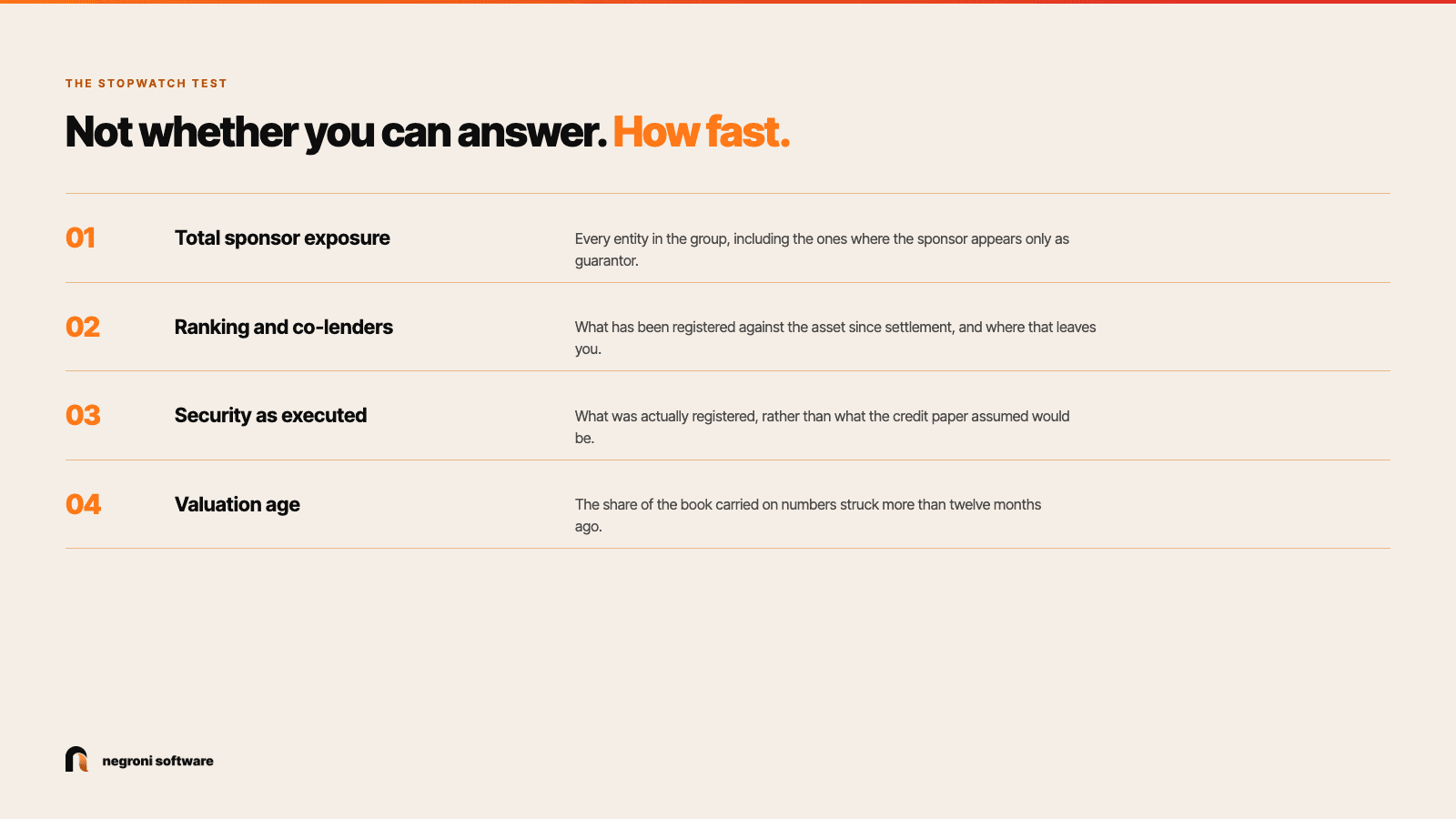
The test: can you produce total sponsor exposure, including guarantor and director relationships, without anyone opening a file?
Two: who else is lending to the same borrower, and where do we rank?
Bathla's collapse has drawn in a large number of funds, which tells you something structural about how Australian private credit has grown. Capital arrived faster than coordination. Multiple managers can lend into the same sponsor group, each with a defensible view of their own facility, none with a view of the total leverage sitting above and beside them.
Ranking is the second half of this question, and it is the half more often assumed than verified. A senior secured position is a ranking within a security pool, not a guarantee about recovery, and the value of that ranking depends entirely on what else has been registered, when, and against which asset. Australian lenders have the advantage of a searchable register. The advantage only pays if somebody searches it after settlement, on a schedule, rather than once at drawdown and never again.
The test: when was the last register search run against your largest twenty security assets, and did anyone find out automatically when a new interest appeared?
Three: is our security actually what we think it is?
Every workout produces at least one facility where the security description in the credit paper and the security registered in reality diverge. A property that was meant to be first-mortgage sole security turns out to be cross-collateralised with two others. A guarantee was executed but never registered. A valuation condition was waived in an email that never made it into the file. A discharge was processed on one title in a group without anyone reassessing the remaining coverage.
None of these are exotic. They are clerical, which is exactly why they survive. Nobody audits the boring parts of a facility until the facility stops paying.
The test: for your ten largest exposures, can you show the executed security position as structured data, linked to the source document, without reading the source document?
Four: what is the valuation based on, and when was it struck?
ASIC has been pressing on valuation practice in private markets for well over a year, and it is not hard to see why. Development valuations are forward-looking by construction. They assume a program, a cost base, a sales rate and an end value, and each of those assumptions has a shelf life. In a market where EY-Parthenon notes the cash rate moved from 3.6 percent to 4.35 percent and construction costs have stayed volatile, a valuation struck eighteen months ago is not a stale number. It is a different number.
The uncomfortable follow-up is what the valuation feeds. LVR drives covenant compliance, covenant compliance drives risk grading, risk grading drives portfolio reporting, and portfolio reporting drives the unit price an investor redeems at. A soft assumption at the bottom of that chain becomes a hard number at the top.
The test: what percentage of your book is carried on a valuation more than twelve months old, and can you produce that percentage today?
Five: if this asset class repriced, how many other loans break?
Correlation is the risk that single-loan reviews structurally cannot see. Three facilities to the same sponsor is a concentration. Eleven loans with the same interest capitalisation structure in the same metropolitan corridor is a correlated position wearing eleven separate file numbers.
EY-Parthenon identified real estate development, construction, hospitality, retail, and transport and logistics as the sectors under pressure in 2026. If your book has meaningful weight in any of those, the relevant question is not how each loan performs. It is how many of them fail together, under what trigger, and whether your fund's liquidity profile survives that timing.
The test: can you run a fifteen percent valuation shock across the entire book, at position level, and get an expected loss number the same day you are asked for it?
Six: can we show what we knew, and when we knew it?
This is the question that arrives last and hurts longest. When a large exposure fails, the inquiry is rarely about whether the credit decision was wrong. Credit decisions are allowed to be wrong. The inquiry is about process: what the fund knew, when it knew it, what it did in response, and whether investors were told anything inconsistent with that.
Answering it requires an evidence trail rather than a memory. Which covenant tests were run and when. Which breaches were waived, by whom, on what basis. Which early warning signals triggered, who investigated, and what the recorded outcome was. A fund that can hand over that trail is in a completely different position to one reconstructing it from email threads while a regulator waits.
The test: could you produce a complete, time-stamped action history on your largest exposure by close of business tomorrow?
The pattern behind all six
Read them together and they are not six questions. They are one question asked six ways: is your loan book a set of documents, or is it a set of data?
Documents are where private credit started, and they are why these questions currently take weeks. A covenant that exists only as a sentence in a scanned PDF cannot be monitored. A guarantor typed as free text into six files cannot be matched. A valuation date sitting in a folder cannot be aged automatically. Every one of the six tests above fails for the same reason, and it is not a credit reason.
This is the layer Negroni is built for. Negroni Automation uses AI document analysis to extract covenants, security details, guarantor entities and reporting obligations into structured fields at intake, with clause-level flagging and confidence scoring, so the obligations that need monitoring exist as data with source-document linkage. Negroni Management runs servicing, collections, compliance and investor reporting on that single record, with an immutable audit trail behind every action, which is the evidence file question answered before it is asked. Negroni Analysis carries the portfolio layer: covenant registers with automatic breach states, multi-scenario stress testing at position level with VaR and expected loss output, weighted average LVR, concentration and geographic exposure across the whole book in minutes.
Software does not answer question one for you in any meaningful sense. It just makes sure that when you answer it, you are reading the whole book rather than the part you could find.
The window
Bathla will run its course through administration. The recoveries will be what the security and the sequencing allow, and the funds involved will spend the next year in workout. For everyone watching from outside the exposure, this is the cheapest lesson available all cycle.
Run the six tests on your own book this week, honestly, with a stopwatch. Wherever the answer is "a few days", you have found the part of your operation that will fail under the next test, and you have found it while it is still a project rather than a crisis.
Frequently asked questions
What are the key questions private credit funds should ask after the Bathla collapse? Following Bathla's approximately $3.5 billion collapse in August 2026, the questions that matter most for private credit funds are total exposure to a single sponsor across all related entities, who else is lending to that sponsor and in what ranking, whether registered security matches what the credit paper assumed, how old the underlying valuations are, how many other loans in the book would break under the same shock, and whether the fund can produce a time-stamped evidence trail of what it knew and when.
How large was the Bathla collapse? Australian Financial Review reporting placed outstanding debts at around $3.5 billion. ABC News reported that Bathla's parent, Universal Property Group, carried approximately $3.2 billion in liabilities, the majority owed to private credit funds rather than to banks. Administrators were appointed on 25 August 2026.
Why is sponsor concentration hard for private credit funds to measure? Because borrower, guarantor and director names are usually stored as free text in individual loan files rather than resolved to a single entity record. The same sponsor can appear under several slightly different strings across a portfolio, and exposures where the sponsor is only a guarantor often sit outside any search. Without entity resolution across the whole book, total sponsor exposure has to be reconstructed manually, which takes days.
What is ASIC focused on in private credit valuations? ASIC has prioritised valuation methodology, disclosure practice and governance frameworks in private markets. The concern is that valuations, particularly forward-looking development valuations, feed loan-to-value ratios, covenant compliance, risk grading and ultimately the unit price at which investors transact, so stale or weakly evidenced valuations propagate through a fund's reporting.
What is the difference between senior secured ranking and downside protection? Senior secured describes a position in a security ranking, not an outcome. Actual recovery depends on what else has been registered against the asset, when those interests were registered, whether security is cross-collateralised, and what the asset realises in an enforcement sale. A senior ranking against an over-valued or encumbered asset can still produce a loss.
How quickly should a private credit fund be able to run a portfolio stress test? Fast enough to answer an investor, board or regulator inside the same conversation, which in practice means hours rather than weeks. A stress test that requires manual data assembly is typically run once a quarter for reporting purposes, which is too infrequent to inform a decision during a live credit event.
Negroni is the AI-powered loan management platform for non-bank lenders, credit funds and private credit managers. Answer the six questions in an afternoon, not a fortnight. Book a demo.
Sources: Australian Financial Review, "Six key questions for private credit amid Bathla's $3.5b collapse", Jonathan Shapiro, 27 August 2026. Australian Financial Review, "Bathla collapse may be Australian private credit's cockroach moment", Chanticleer, 25 August 2026. ABC News, "ASIC warns of 'first significant cracks' in Australian private credit", David Taylor, 27 August 2026. EY-Parthenon, "Australia's private credit market enters a new phase", David Kennedy and Martie Tziotis, 22 July 2026.


