Arrears Are a Lagging Indicator: Building an Early Warning System in a Private Credit Loan Book
By the time a loan is thirty days in arrears, the deterioration is months old. The signals that move first in a private credit book, and how to monitor them without adding headcount.


David Ellett
Co-Founder & CEO
Share now :


Ask a credit team how the book is performing and you will usually get an arrears number. It is the industry’s default health metric: current, thirty days, sixty, ninety, and the ratios that follow. Investors ask for it, boards review it, and it appears at the top of every portfolio report ever written.
It is also the wrong place to look first, because a missed payment is the end of a process rather than the beginning of one.
A borrower who misses a scheduled payment has usually been deteriorating for three to nine months. Cash got tight, so they stretched suppliers. Then they drew on a facility they had been leaving idle. Then they delayed a tax payment, deferred a capital purchase, lost a key contract, or watched a construction program slip past the point where the feasibility still worked. Somewhere in that sequence they made a decision about which creditor to disappoint first, and a secured lender with enforcement rights is rarely at the top of that list. By the time your payment is late, you are seeing the consequence of a decision made a long time ago.
The lenders who recover well are not the ones with the best arrears process. They are the ones who never needed it, because they intervened while the borrower still had options.
The signals that move before the payment does
Deterioration announces itself, quietly, in places most loan books do not systematically watch.
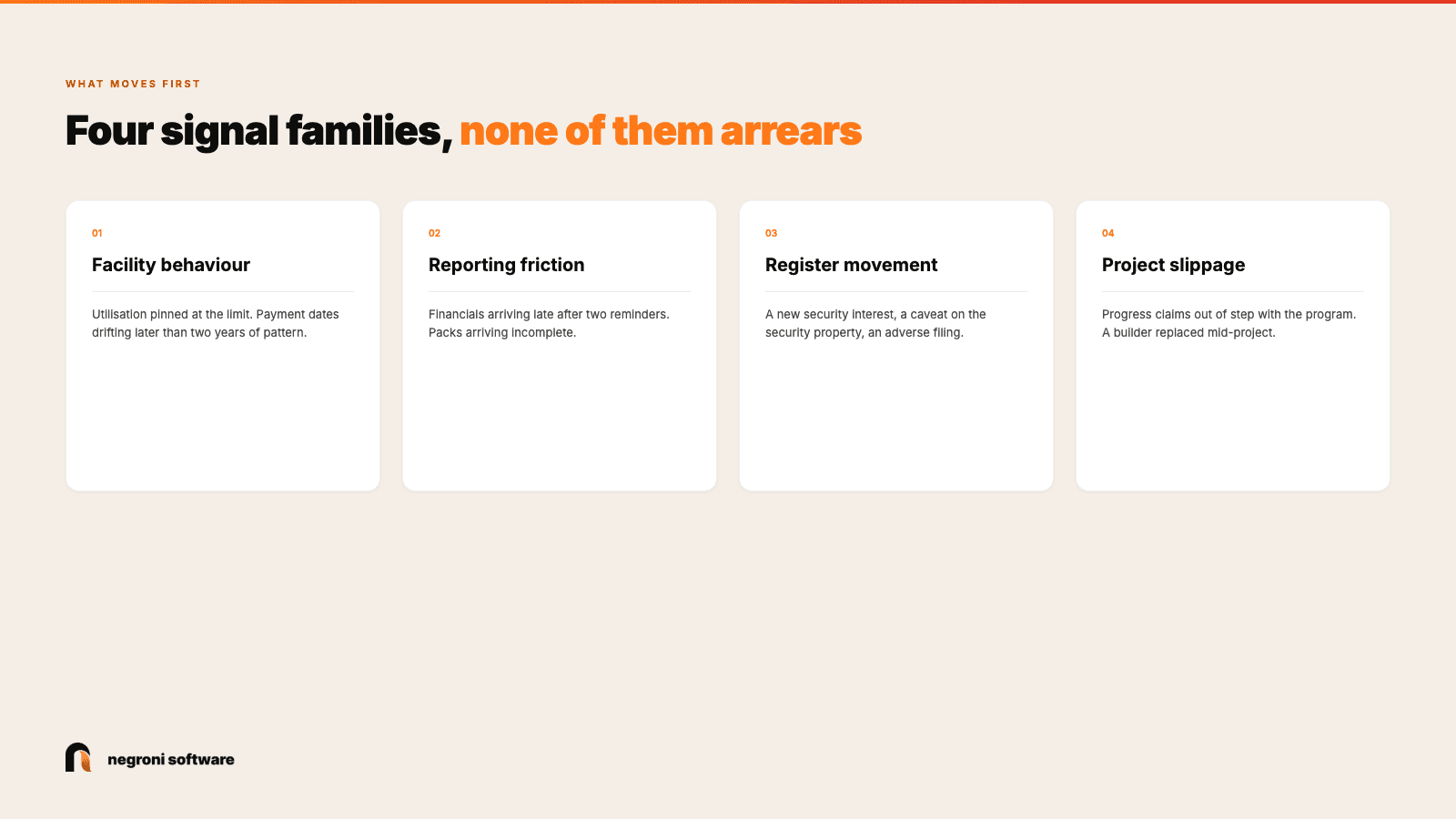
Behaviour around the facility itself. A borrower who has drawn to the limit and stayed there, when the facility was structured for revolving use, is telling you something. So is a borrower who suddenly requests a redraw they have never used, who starts paying on the last possible day after two years of paying early, whose direct debit fails once and is quietly re-presented, or who begins asking about the discharge process for one asset in a cross-collateralised group. None of these is a breach. All of them are information, and all of them sit in servicing data you already hold.
Reporting friction. Late financials are the single most reliable early signal in secured lending, and the most consistently tolerated. A borrower whose management accounts arrived on the fifteenth for eighteen months and now arrive on the twenty-eighth, after two reminders, is not being disorganised. Incomplete reporting packs, aged debtor listings that stop being provided, a bank statement covering a shorter period than requested, a valuation instruction that keeps getting deferred: friction in reporting almost always precedes friction in cash.
Counterparty and register movement. A new security interest registered against the borrower or a related entity, a caveat lodged on a secured property, a director resignation, an ASIC filing change, an adverse court listing, a statutory demand, a subcontractor lodging a payment claim on a project you are funding. These are public or semi-public facts that a lender can monitor, and they frequently appear weeks before the borrower volunteers anything.
Project-level slippage. In construction and development lending, the earliest signal of all is usually physical. Progress claims that no longer match the program, a quantity surveyor’s report noting a variation the borrower has not mentioned, a builder replaced mid-project, presales that fail to convert, a certificate that should have been issued last month. Development finance deteriorates on site long before it deteriorates in the bank account.
Concentration and correlation. Some deterioration is not about a single borrower. Three loans to the same sponsor. Four facilities secured against property in one postcode. A guarantor appearing across six files. An interest rate move that stresses eleven loans simultaneously because they all have the same structure. A single-loan view will never surface any of that.
Why most lenders see none of it in time
The signals above are not obscure. Every experienced credit person reading this list is nodding, and could add five more. The problem is not knowledge, it is retrieval.
In a typical non-bank lender, drawdown behaviour lives in the loan servicing spreadsheet. Reporting due dates live in a diary or a set of calendar reminders that one person maintains. Executed covenants live in PDFs in a shared drive. Register searches happen at origination and annual review, if at all. Progress claims arrive as email attachments to whoever manages that facility. Concentration is calculated when somebody asks for it, usually for an investor report.
Each fragment is monitored by somebody. Nothing is monitored together, and deterioration is a pattern across fragments rather than an event within one. A borrower stretching payment dates while their financials arrive late while a new caveat appears on the security property is a screaming signal. The same three facts, distributed across a spreadsheet, an inbox and a search nobody has run since settlement, are invisible. It is the same blindness that lets a double-pledged asset sit undetected until administration.
There is a human factor too, and it deserves saying plainly. Early signals are ambiguous, and chasing them creates awkward conversations with good borrowers. A relationship manager who calls a client about a slightly late reporting pack has spent relationship capital on something that will turn out to be nothing eighty percent of the time. Left to individual discretion, that call often does not get made. Systems do not have that hesitation, which is exactly why the trigger should sit in the system rather than in someone’s judgement about whether it is worth the friction.
What an early warning system looks like in practice
An early warning framework has four parts, and none of them require a data science team.
First, a defined signal set with thresholds. Write down the fifteen to twenty-five indicators that matter in your asset classes, and define what constitutes a trigger for each. Reporting more than ten days late. Utilisation above ninety-five percent for two consecutive months. Any new registered interest against a security asset. Payment date drifting more than five days from historical pattern. Progress claim variance above ten percent. The specific thresholds matter far less than the fact that they are written down and applied consistently.
Second, automatic detection. A signal that depends on somebody remembering to check it is not a signal, it is a hope. Detection needs to run against live loan data on a schedule, without human initiation.
Third, tiered escalation. Not every trigger warrants a phone call. A single amber signal might generate a note on the file and a diary item. Two amber signals on the same facility within sixty days might warrant a borrower call and a fresh register search. A red signal, or three ambers, should route to the credit committee with a recommendation. Tiering is what makes the system usable; an early warning framework that treats everything as urgent gets ignored within a month.

Fourth, a closed loop. Every triggered signal needs a recorded outcome: investigated and cleared, monitored, escalated, or acted on. This does two things. It creates the evidence trail that regulators and auditors now expect, showing the fund actively monitored rather than passively reported. And it lets you tune the framework, because after twelve months you can see which signals actually predicted trouble in your book and which generated noise. The same discipline underpins automated collections and arrears management, which is where these signals end up when nobody catches them early.
The operational requirement underneath all of it
Every element above assumes one thing: that loan data is structured, current and queryable in one place. That assumption is where most early warning projects die.
You cannot automatically detect a covenant breach if the covenant exists only as a sentence in a scanned facility agreement. You cannot flag reporting friction if due dates live in someone’s calendar. You cannot spot a guarantor appearing across six facilities if guarantor names were typed as free text into six different files, three of them with abbreviations. You cannot see concentration if calculating it takes two days.
This is why early warning is fundamentally a data architecture problem wearing a risk management costume. Negroni Automation extracts covenants, reporting obligations, security details and guarantor entities into structured fields at intake, using AI document analysis, so the obligations that need monitoring exist as data rather than as prose. Negroni Management runs servicing, collections and compliance on that single record, which means payment behaviour, reporting status and arrears sit in the same place as the covenant they relate to, with an immutable audit trail capturing every action taken on every signal. Negroni Analysis handles the portfolio layer, modelling rate shifts, defaults and concentration risk across the whole book in minutes, which is where correlated deterioration becomes visible before it becomes correlated default.
The return on this is not really about avoiding losses, although it does that. It is about optionality. A lender who identifies deterioration at month two has the full toolkit available: a restructure, additional security, a sponsor equity injection, an orderly sale, a refinance to another lender who has not yet seen the problem. A lender who identifies it at month nine has enforcement and a queue. Same loan, same borrower, vastly different recovery, and the only variable is how early somebody noticed.
Arrears will always be worth reporting. Just stop treating it as the thing you monitor, and start treating it as the thing that happens when monitoring failed.
Frequently asked questions
What are early warning indicators in lending? Early warning indicators are measurable signals that a borrower’s credit quality is deteriorating before a payment is missed or a covenant is formally breached. In private credit they typically include late or incomplete financial reporting, changes in facility utilisation, drift in payment timing, newly registered security interests or caveats, adverse court or regulatory filings, construction program slippage, and concentration exposures across related borrowers or guarantors.
Why are arrears considered a lagging indicator? Because a missed payment is the outcome of a cash flow problem that usually developed over three to nine months. Borrowers typically stretch suppliers, draw down available facilities and defer other obligations before defaulting to a secured lender with enforcement rights. Arrears therefore confirm deterioration that has already occurred rather than warning of deterioration that is beginning.
How many early warning signals should a lender monitor? Most non-bank lenders are well served by fifteen to twenty-five clearly defined indicators with explicit thresholds, tailored to their asset classes. Consistency matters more than volume; a small set of signals applied to every loan automatically outperforms a long list applied selectively.
How should early warning signals be escalated? Through tiers rather than uniformly. A single low-severity trigger might generate a file note and a review date, multiple triggers on one facility within a defined window should prompt borrower contact and fresh register searches, and high-severity triggers should route directly to credit committee with a recommendation. Every trigger should have a recorded outcome to create an evidence trail and allow the framework to be tuned over time.
What data does an early warning system need? Structured, current data in a single system: covenants and reporting obligations extracted as fields rather than held in documents, servicing and payment behaviour on the same record, guarantor and security entities resolved consistently so they can be matched across facilities, and portfolio-level analytics capable of surfacing concentration and correlated exposures on demand.
Negroni is the AI-powered loan management platform for non-bank lenders, credit funds and private credit managers. See deterioration at month two, not month nine. Book a demo.


