Private Credit's Cockroach Moment: The Problem Was Never the Information
Bathla did not fail quietly. Many of the warning signs were public for months, which makes the collapse look more like a retrieval problem than an information problem. What Australian private credit lenders can take from it.


David Ellett
Co-Founder & CEO
Share now :


When the Australian Financial Review’s Chanticleer column called the Bathla collapse a possible “cockroach moment” for Australian private credit on 25 August, the most pointed line in the piece was not about cockroaches at all. It was the argument that lenders caught badly off guard by this particular failure will face some uncomfortable questions, because the collapse of the Sydney home builder did not arrive without warning. Chanticleer pointed to concerns about the group’s debt levels, its cash flow pressures and its building practices, which had been building for months.
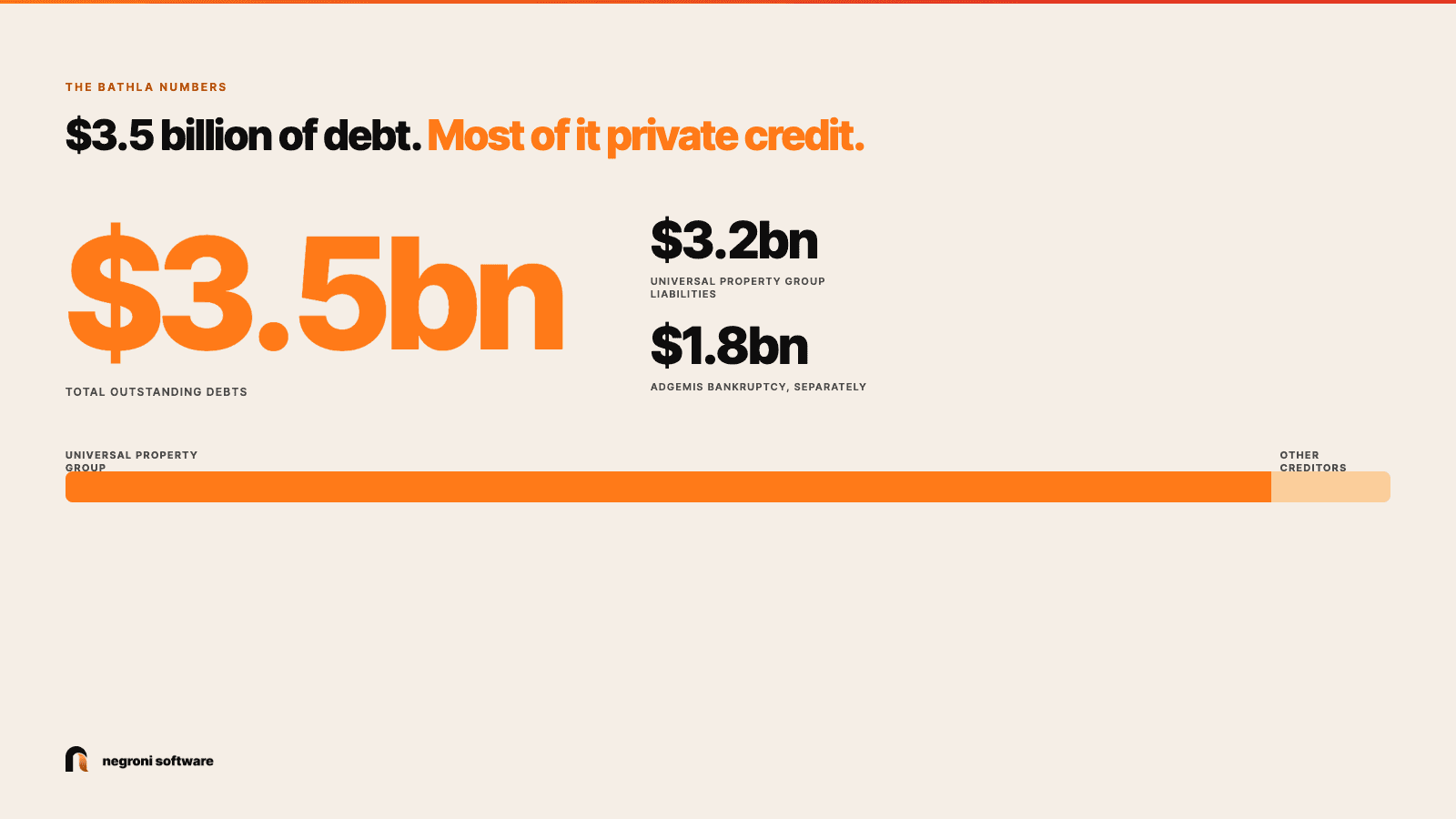
That framing is worth pausing on, because it inverts the usual post-mortem. The standard story after a credit event is that the information was hidden, the borrower misled, the fraud sophisticated. This does not appear to be that story. Much of the information was available. It was in the public record, in the trade press, in the conversations lenders were having with each other. And a number of funds now find themselves exposed to a group whose parent, Universal Property Group, carried $3.2 billion in liabilities, most of it owed to private credit funds, according to the ABC’s reporting on 27 August.
That is a different kind of failure, and a more uncomfortable one. It is not a failure of information. It is a failure of retrieval.
The cockroach metaphor is about the ones you have not found
The metaphor comes from the idea that a single visible pest implies a population you have not yet seen, and it entered credit market vocabulary during the offshore defaults of the past eighteen months. Applied to Australia, it raises a fair question rather than a verdict: if Bathla is the one that surfaced, are there others working through parts of the same sequence in some loan books, a few months behind on the same curve?
Reserve Bank Governor Michele Bullock put the same worry more plainly, telling reporters that people do not know where the leverage sits and do not know who is exposed. ASIC chair Sarah Court described the situation as the first significant cracks in the sector and the first real test for private credit in this country.
Both statements are about visibility rather than solvency. Neither regulator is saying the sector is unsound. They are saying that a complete map is difficult for anyone to produce right now. And in a market that EY-Parthenon sized at A$234.5 billion of Australian private debt assets under management in 2025, that visibility gap is a large part of the story.
Here is the part that deserves attention from any credit manager reading this. If your response to Bathla was to confirm you had no exposure, you have answered the easy question. The harder question is how long that confirmation took. If confirming your position across every facility, every guarantor, every related entity and every co-lender took a week of somebody pulling files, then the position was discovered rather than known. Those are different operational states, and the difference matters most in periods like this one.
Fragmentation is what turns public information into invisible information
The reason experienced credit teams miss signals they could recite from memory is not competence. It is architecture.
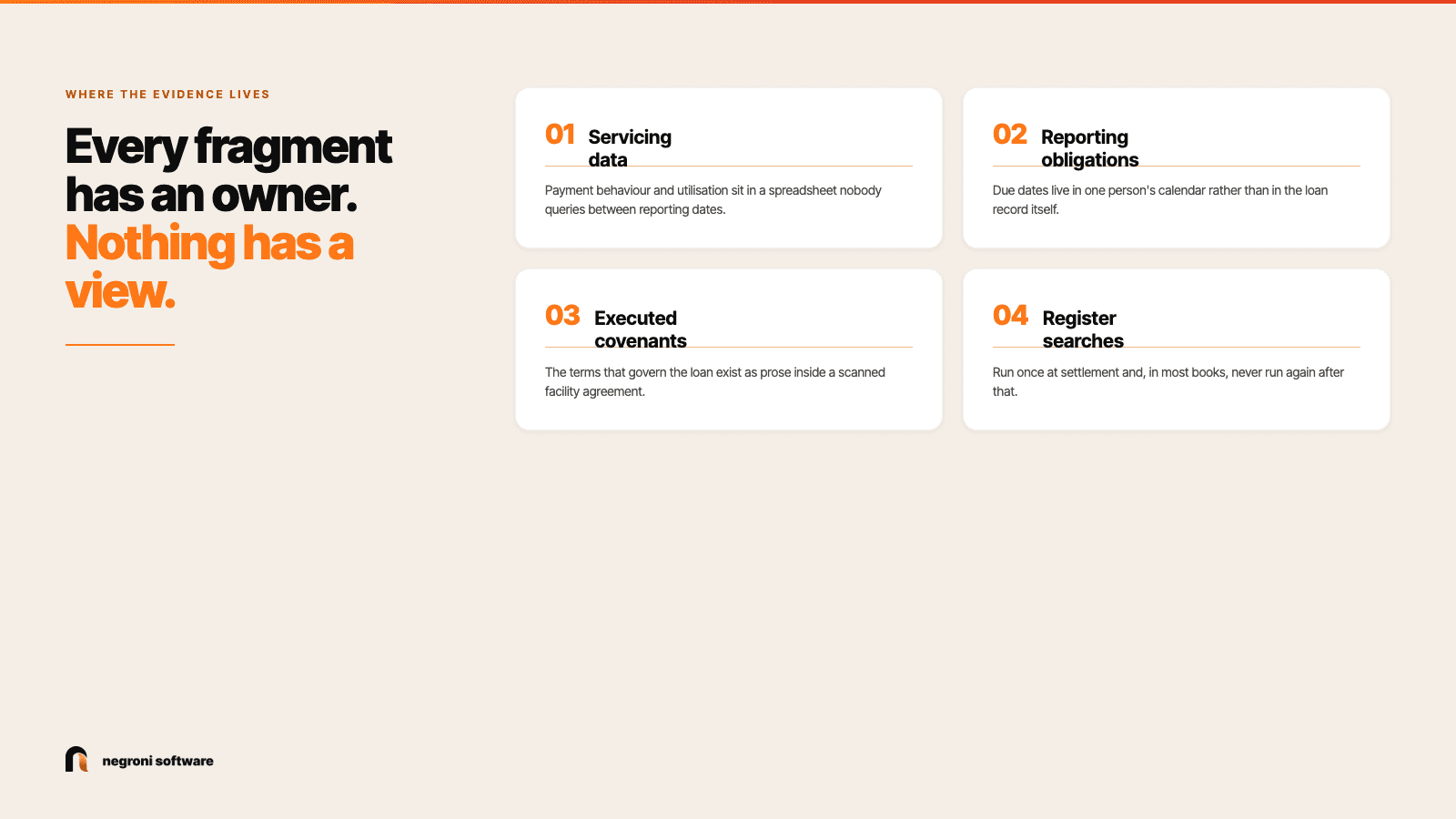
In many non-bank lenders, the pieces of the Bathla picture would have lived in separate places. Media coverage of building defects sits in an inbox or nowhere. Payment behaviour sits in a servicing spreadsheet. Registered security interests were searched at settlement and possibly never again. Guarantor and director names were typed as free text into individual files, sometimes with abbreviations, so the same person can appear three different ways across three facilities. Progress claims arrive as email attachments to whichever analyst manages that project. Concentration by sponsor often gets calculated when an investor asks, usually in a spreadsheet built for the occasion.
Every fragment has an owner. Nothing has a view. Deterioration is a pattern across fragments, not an event inside one, so a portfolio that holds all the evidence can still miss the conclusion. That is the kind of blind spot that can let a double-pledged asset sit undetected until administration, and a version of it appears to have been at work here.
There is a second factor, and it is human rather than technical. Early signals are ambiguous and expensive to chase. A relationship manager who calls a good borrower about a slightly late reporting pack has spent relationship capital on something that turns out to be nothing most of the time. In a hot market, with capital competing for deals, that call gets deferred. Nobody decides to ignore a warning. The warning simply never reaches a forum where ignoring it would require a decision.
The test is not whether you lent to Bathla
The Bathla exposure will be worked through in the administration process, and the recoveries will be what the security and the sequencing allow. The more useful exercise is to treat this period as a fire drill and take stock of your own operation against the questions a regulator, an investor or a board may reasonably ask right now.
Can you produce, today, a list of every facility connected to a single sponsor, including entities where that sponsor appears only as a guarantor or a director? Can you show, without a manual search, which security properties have had a new interest or caveat registered since settlement? Can you say how many borrowers are more than ten days late on their reporting obligations, and how that number has moved over six months? Can you model what happens to your book if development valuations in one metropolitan corridor fall by fifteen percent, and produce the answer in an afternoon rather than a fortnight?
Many Australian non-bank lenders can answer all of those questions eventually. Fewer can answer them on demand. The gap between eventually and on demand is the gap between intervening at month two, when a restructure, an equity injection or an orderly sale is still available, and intervening at month nine, when the only remaining option is enforcement and a queue.
Capital scaled faster than the operating model
The uncomfortable pattern underneath the Bathla week is that parts of Australian private credit grew into a bank-scale asset class faster than their operating models matured. Some funds that were managing thirty loans on a spreadsheet in 2020 are managing three hundred on a slightly bigger spreadsheet in 2026. In most cases the credit judgement kept improving. The infrastructure carrying that judgement has not always kept pace.
Regulators have noticed. ASIC has been sharpening its focus on valuation methodology, disclosure and governance, and EY-Parthenon’s read of the market is that differentiation now comes from underwriting discipline, governance and the ability to manage complexity through a cycle rather than from access to capital. Investors have noticed too, which is what redemption restrictions at several funds are ultimately about.
This is where the operating model becomes a credit issue rather than an efficiency issue. Negroni exists to close that gap: Negroni Automation extracts covenants, security details, guarantor entities and reporting obligations into structured fields at intake using AI document analysis, so obligations exist as data rather than as prose buried in a scanned facility agreement. Negroni Management runs servicing, collections and compliance on that single record with an immutable audit trail, so payment behaviour and reporting status sit beside the covenant they relate to. Negroni Analysis handles the portfolio layer, modelling rate shifts, defaults and concentration risk across the whole book in minutes rather than weeks, which is where a sponsor appearing across six files stops being a coincidence and starts being a number.
None of that makes the credit call for you. It makes sure the credit call is made with the whole picture in the room, which is the only part of this that software can honestly claim.
What to do this week
Run the exercise. Pick your three largest sponsor relationships and try to assemble the complete exposure picture from scratch, timing yourself. Then pick the fifteen to twenty-five signals that actually matter in your asset classes, write down the thresholds that constitute a trigger, and decide which of them a system can detect without anyone remembering to look.
Much of what mattered at Bathla was visible. The next stress event will likely be visible too. The question is not whether the information exists. It is whether your loan book is set up to see it.
Frequently asked questions
What is private credit’s “cockroach moment”? A cockroach moment describes a single visible credit failure that implies further undetected problems in the same market, on the logic that one pest rarely lives alone. The Australian Financial Review applied the phrase to the collapse of Sydney home builder Bathla in August 2026, arguing that the more important question was not the Bathla exposure itself but what similar exposures remain unidentified across Australian private credit portfolios.
Why did the Bathla collapse affect so many private credit funds? Bathla’s parent, Universal Property Group, carried approximately $3.2 billion in liabilities according to ABC reporting, with the majority owed to private credit funds rather than banks. Jonathan Shapiro reported in the Australian Financial Review that outstanding debts across the collapse total around $3.5 billion. The number of funds involved reflects both the size of the development group and the fragmentation of the private credit lending market, where multiple managers can lend into the same sponsor group without a shared view of total leverage.
What did ASIC say about the Bathla collapse? ASIC chair Sarah Court described the situation as the first significant cracks in Australian private credit and the sector’s first real test in this country. The comments came as several non-bank lenders restricted investor redemptions and as the regulator continued a broader focus on valuation practices, disclosure and governance in private markets.
Was the Bathla collapse foreseeable? The Australian Financial Review’s Chanticleer column argued that it was, pointing to escalating concerns over the group’s debt levels, cash flow position and building practices in the months before administrators were appointed on 25 August 2026. That framing makes the event less a failure of available information than a failure to assemble information that lenders already held in separate systems.
How can a private credit fund tell whether it has hidden exposure to a distressed sponsor? By resolving borrower, guarantor, director and related-entity names to a single record across every facility, then querying that record rather than searching files. A fund that can produce total sponsor exposure on demand, including entities where the sponsor appears only as a guarantor, knows its position. A fund that has to reconstruct the answer from spreadsheets and PDFs is discovering its position, which takes days it may not have.
What should Australian non-bank lenders do differently after Bathla? Define a written set of early warning indicators with explicit thresholds for their asset classes, automate detection so signals do not depend on someone remembering to check, tier escalation so that not every trigger demands a phone call, and record an outcome against every triggered signal to build the evidence trail regulators and auditors increasingly expect.
Negroni is the AI-powered loan management platform for non-bank lenders, credit funds and private credit managers. Know your total sponsor exposure in seconds, not after a week of pulling files. Book a demo.
Sources: Australian Financial Review, “Bathla collapse may be Australian private credit’s cockroach moment”, Chanticleer, 25 August 2026. Australian Financial Review, “Six key questions for private credit amid Bathla’s $3.5b collapse”, Jonathan Shapiro, 27 August 2026. ABC News, “ASIC warns of ‘first significant cracks’ in Australian private credit”, David Taylor, 27 August 2026. EY-Parthenon, “Australia’s private credit market enters a new phase”, David Kennedy and Martie Tziotis, 22 July 2026.


