From Access to Quality: EY's Read on a A$234.5 Billion Market Is an Operating Model Warning
EY-Parthenon says Australia's A$234.5 billion private credit market has moved from a growth phase to a resilience phase, and that manager performance will diverge. The dividing line is operational, not strategic.


David Ellett
Co-Founder & CEO
Share now :


EY-Parthenon published its view of Australian private credit on 22 July, five weeks before Bathla's administrators walked in. Reading it now, with $3.5 billion of collapse on the table and several funds restricting redemptions, the piece looks less like commentary and more like a weather report filed before the storm.
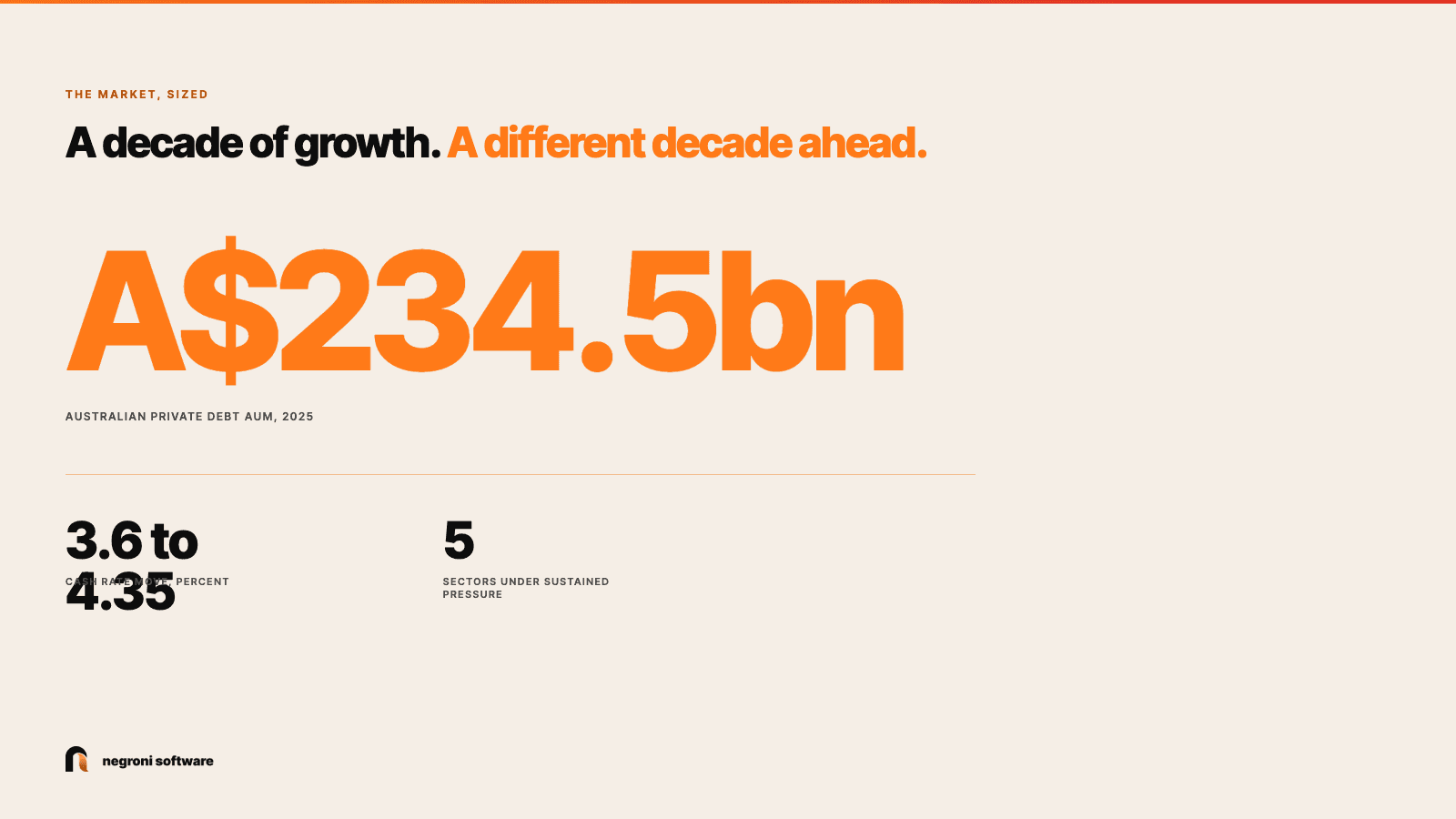
Partners David Kennedy and Martie Tziotis put Australian private debt assets under management at A$234.5 billion in 2025, and framed the market as having completed its transition from alternative funding source to core component of the corporate financing ecosystem. Then came the sentence that does the real work: private credit's evolution in Australia is shifting the conversation from access to capital toward the quality of capital.
That is an elegant way of describing an ugly transition. For a decade, the winning question in Australian private credit was whether you could deploy. Capital was the scarce thing, borrowers were plentiful, and speed to funding was a genuine competitive weapon. The market now being described is one where deployment is table stakes and the scarce thing is the quality of what you deployed into, which is a completely different operational problem.
Growth rewarded one set of muscles. Resilience rewards another.
Kennedy and Tziotis describe a market moving from growth to resilience and execution, with 2026 conditions exposing differences in underwriting discipline and portfolio quality. They list the pressures: geopolitical tension, inflation, a cash rate that moved from 3.6 percent to 4.35 percent, and rising offshore defaults. They identify real estate development, construction, hospitality, retail, and transport and logistics as the sectors carrying the strain.
The uncomfortable implication is that the capabilities that produced the last decade of growth are not the capabilities the next phase demands. Origination speed, relationship depth and a willingness to price risk that banks would not touch built these books. What protects them now is a different discipline entirely: monitoring, covenant enforcement, valuation currency, concentration awareness and the ability to intervene early on a deteriorating position.
Very few Australian non-bank lenders built the second set of muscles while they were exercising the first. That is not a criticism of anyone's judgement. It is what happens when a market grows quickly. Headcount goes into origination because origination is where the revenue is, and portfolio management gets covered by the same three people who did it when the book was a third of the size.
"Enhanced covenant structures" is a data claim, not a legal one
EY-Parthenon notes that new transactions increasingly feature rigorous due diligence, enhanced covenant structures and a greater focus on downside risk analysis. That is exactly what a maturing market should produce, and it is also where a quiet gap opens between what a fund has negotiated and what a fund can actually operate.
A tighter covenant package is only as good as the monitoring behind it. A financial covenant tested quarterly against management accounts that arrive late, reviewed by an analyst who has forty-two other files, in a portfolio where the covenant itself exists as a paragraph inside a scanned facility agreement, is a legal right rather than a risk control. It gives you a position in a workout. It does not give you the early warning the tighter drafting was supposed to buy.
The same applies to downside risk analysis. Analysis performed at credit approval and never refreshed is a document. Analysis that runs against the live book whenever an assumption moves is a control. The distinction rarely shows up in a credit paper and always shows up in a workout.
So when EY-Parthenon says quality of capital, one honest translation is this: quality is whatever survives contact with your operating model. A well-structured loan managed on a spreadsheet degrades into an averagely structured loan within about eighteen months, because the structure stops being visible to the people responsible for enforcing it.
Restructuring capability is now a competitive asset
One of the more striking observations in the EY-Parthenon piece is that private lenders are increasingly managing distress situations traditionally handled by banks, particularly in construction, real estate and hospitality. The authors treat active portfolio management and sector expertise as genuine differentiators.
This is a significant shift in what a private credit manager is. Banks built entire workout departments, with dedicated teams, defined escalation protocols, standardised distressed asset reporting and institutional memory of what worked in the last cycle. Australian non-bank lenders are being handed the same job with a fraction of the infrastructure, usually while also running origination.
Doing that well requires knowing which positions need attention before they need rescue. A workout that begins at month two has the full toolkit available: restructure, additional security, sponsor equity injection, orderly sale, or refinance to a lender who has not yet seen the problem. A workout that begins at month nine has enforcement and a queue. Same loan, same borrower, materially different recovery, and the only variable is when somebody noticed.
That is the operational case for early warning frameworks, and it is why arrears is the wrong headline metric for a book under stress. A missed payment confirms deterioration that started three to nine months earlier.
Divergence is decided by infrastructure
The forecast at the end of the EY-Parthenon analysis is the part worth pinning above a credit committee table: performance will diverge among managers, determined by disciplined underwriting frameworks, portfolio diversification, robust governance and sector expertise. Capital remains available, but lenders will increasingly emphasise cash flow resilience and prudent leverage.
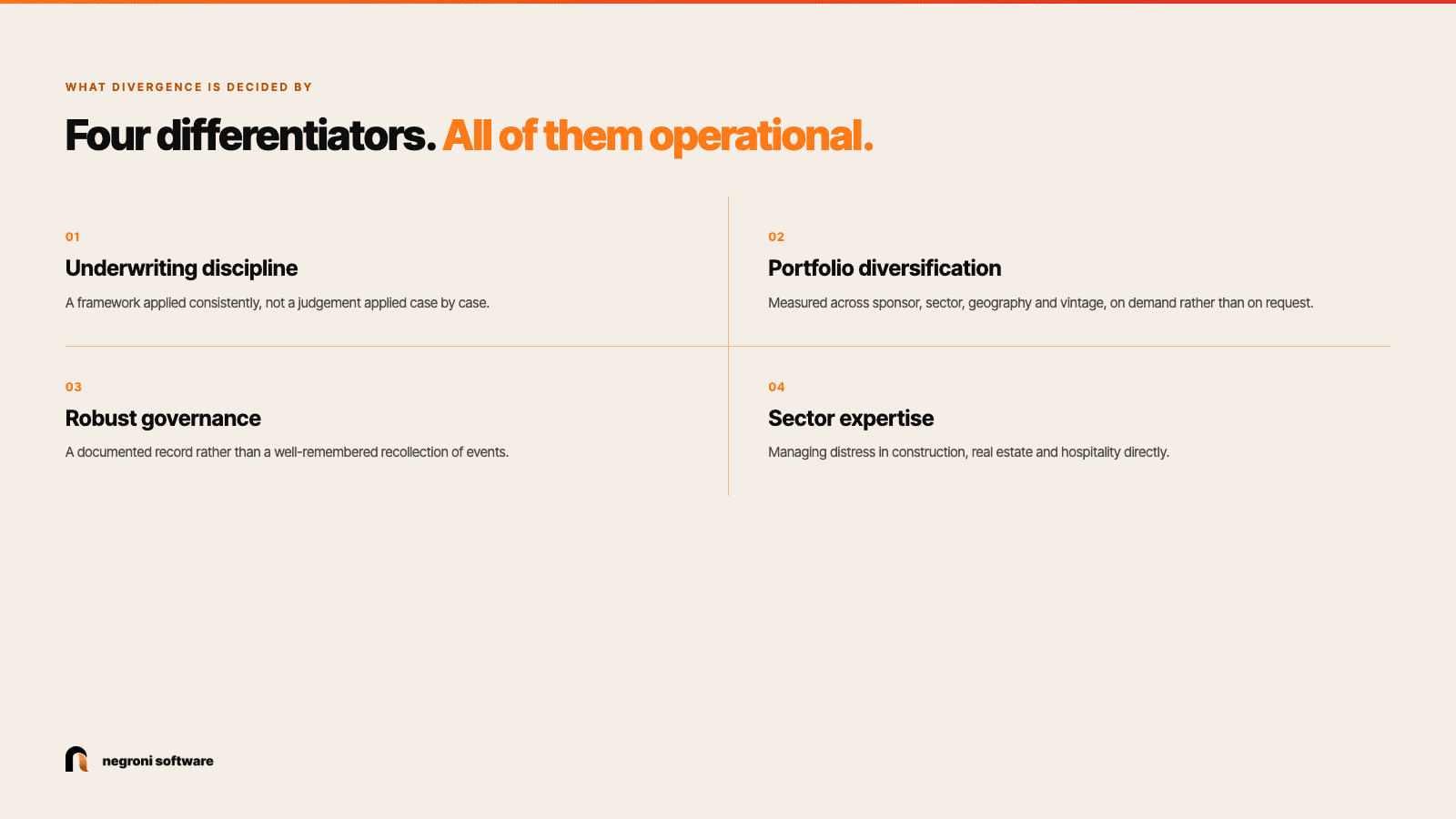
Divergence is a comfortable word until you are on the wrong side of it. In practice it means investors will start distinguishing between managers who look similar in a factsheet, and the distinguishing evidence will be operational: how quickly a manager can answer a hard question, how current their valuations are, whether their governance produces a record or a recollection, and whether they identified their problem loans before or after the payments stopped.
Every item on that list is a systems question wearing a strategy costume. This is where Negroni fits. Negroni Automation uses AI document analysis to extract covenants, security details, guarantor entities and reporting obligations into structured fields at intake, with clause-level flagging, confidence scoring and source-document linkage, which is what turns an enhanced covenant structure into something a system can actually monitor. Negroni Management runs servicing, collections, compliance and both staff and investor reporting on that single record, with an immutable audit trail and branded investor output drawn from live data. Negroni Analysis carries the portfolio layer: covenant registers with automatic warning and breach states, multi-scenario stress testing at position level with VaR and expected loss output, weighted average LVR and life, LVR distribution bands, risk rating mix, vintage analysis and geographic concentration across the whole book in minutes rather than weeks.
The pitch is not that software underwrites better. It does not. The pitch is that in a phase where differentiation comes from governance, monitoring and speed of response, the manager whose book is structured data has a structural advantage over the manager whose book is documents, regardless of who has the better credit instincts.
The phase change is already priced
EY-Parthenon wrote in July that the market was entering a new phase. August provided the demonstration. ASIC has called it the first real test, the RBA has said publicly that nobody knows where the leverage sits, and several funds have limited redemptions.
None of that changes the strategic case for private credit in Australia. Borrowers still need capital that banks will not provide, and the asset class still earns its premium. What has changed is that the market will now sort managers on evidence rather than on narrative, and evidence is an operational output.
Build the machine that produces it, or spend the next two years explaining why you cannot.
Frequently asked questions
How big is Australia's private credit market? EY-Parthenon reported that Australian private debt assets under management reached A$234.5 billion in 2025, describing the market as having moved from an alternative funding source to a core component of Australia's corporate financing ecosystem over roughly a decade of rapid growth.
What does "quality of capital" mean in private credit? EY-Parthenon uses the phrase to describe a market where access to capital is no longer the constraint, so competition shifts to the quality of what was deployed: underwriting discipline, covenant structure, portfolio diversification, governance and the ability to manage a position through deterioration. In practice it means managers are judged on how loans perform and how they are managed rather than on how quickly they were written.
Which sectors are under most pressure in Australian private credit? EY-Parthenon identified real estate development, construction, hospitality, retail, and transport and logistics as the sectors carrying the greatest strain in 2026, against a backdrop of inflation pressure, geopolitical volatility, a cash rate move from 3.6 percent to 4.35 percent, and rising private credit defaults internationally.
Why are private credit funds now handling restructuring work that banks used to do? Because private lenders now hold much of the corporate and development lending that banks stepped back from, particularly in construction, real estate and hospitality. When those positions deteriorate, the restructuring falls to the lender that holds the paper. EY-Parthenon treats active portfolio management and sector expertise in distressed situations as genuine competitive differentiators for private credit managers.
What will separate strong private credit managers from weak ones in this cycle? EY-Parthenon forecasts performance divergence driven by disciplined underwriting frameworks, portfolio diversification, robust governance and sector expertise. Operationally, that divergence shows up as how quickly a manager can answer questions about exposure, how current its valuations are, whether governance produces a documented record, and whether problem loans are identified before payments are missed.
Does a tighter covenant package actually reduce risk? Only if the covenants are monitored. A covenant that exists as a clause inside a scanned facility agreement, tested manually against reporting that arrives late, functions as a legal right in a workout rather than as an early warning control. Covenant structures reduce risk when they are held as structured data with automatic testing and breach states against live loan information.
Negroni is the AI-powered loan management platform for non-bank lenders, credit funds and private credit managers. Be on the right side of the divergence. Book a demo.
Sources: EY-Parthenon, "Australia's private credit market enters a new phase", David Kennedy and Martie Tziotis, 22 July 2026. ABC News, "ASIC warns of 'first significant cracks' in Australian private credit", David Taylor, 27 August 2026. Australian Financial Review, "Six key questions for private credit amid Bathla's $3.5b collapse", Jonathan Shapiro, 27 August 2026.


